
Under department policy, a treatment variance must be documented during the same shift with the event timing, dose delivered, and everyone notified. After a pelvis fraction, verification imaging shows the patient was misaligned during part of the beam-on time, and the physician and physicist are both reachable right now. Which entry satisfies the policy?
Select an answer to reveal the explanation.
Short Explanation
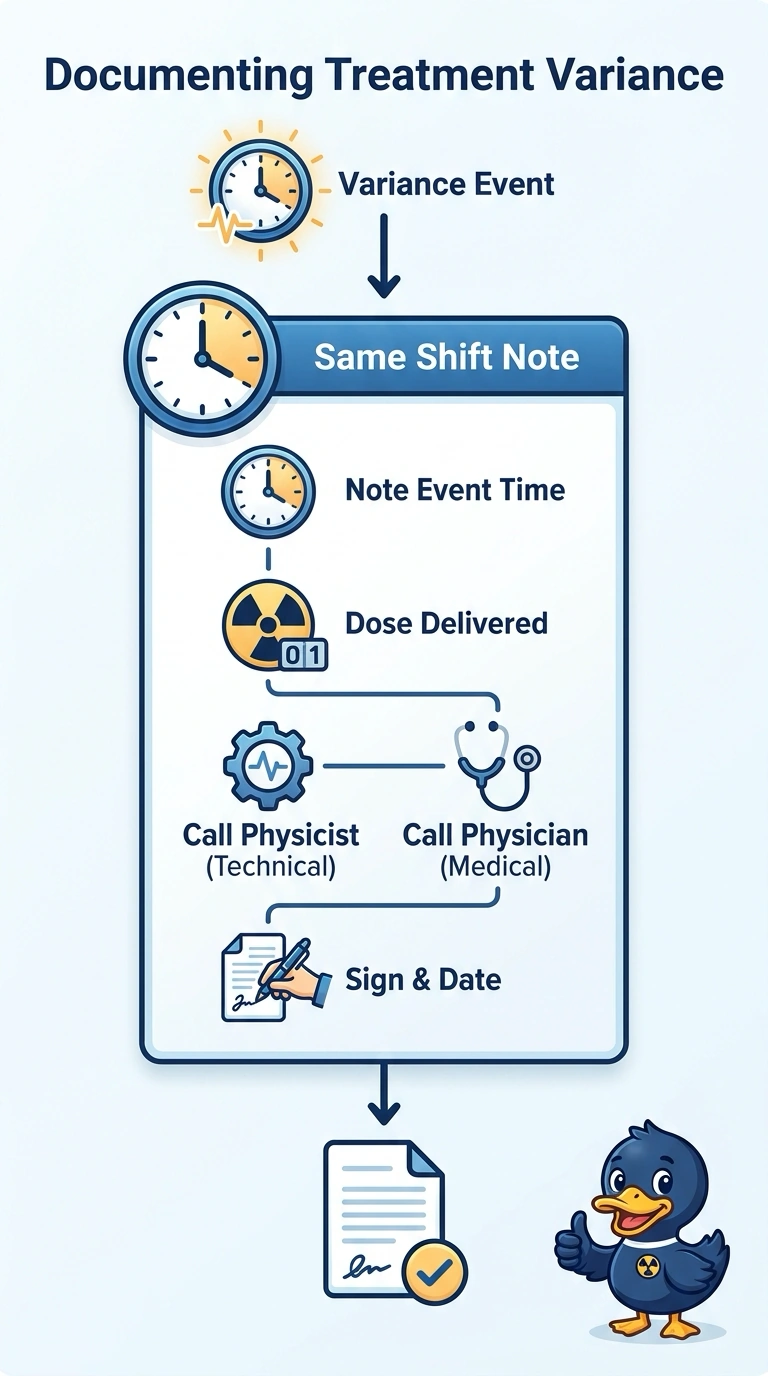
Your variance note is like a three-part receipt: it needs the event time, dose delivered, and everyone notified. Sign it during the same shift, while the physician and physicist are reachable.
Full Explanation
The correct entry is a signed note completed during the same shift that records the event time, dose delivered, and notification of both the physician and physicist. These details make the treatment variance traceable: the timing identifies when the misalignment occurred, the delivered dose documents the exposure, and the notification record shows that the relevant clinicians were informed. The incomplete-event documentation approach fails because it records the time and notifications but omits the dose delivered, a required element. The partial-notification approach fails because it records the time and dose but documents only the physicist’s notification, leaving out the physician. The deferred retrospective documentation approach fails because a note made at the weekly chart audit does not meet the same-shift timing requirement, even if it includes all the required details. Exam caveat: these requirements come from the stated department policy and should not be generalized into a universal federal documentation rule. Practical check: before signing, verify that the note includes the event time, the dose actually delivered, the same-shift entry time, and the names or roles of both notified clinicians.