
A patient undergoing pelvic radiation therapy asks the therapist to explain the skin redness that appeared steadily as the dose accumulated, and also whether treatment could raise her chance of leukemia later in life. Which classification correctly pairs these two outcomes with their radiation effect types?
Select an answer to reveal the explanation.
Short Explanation
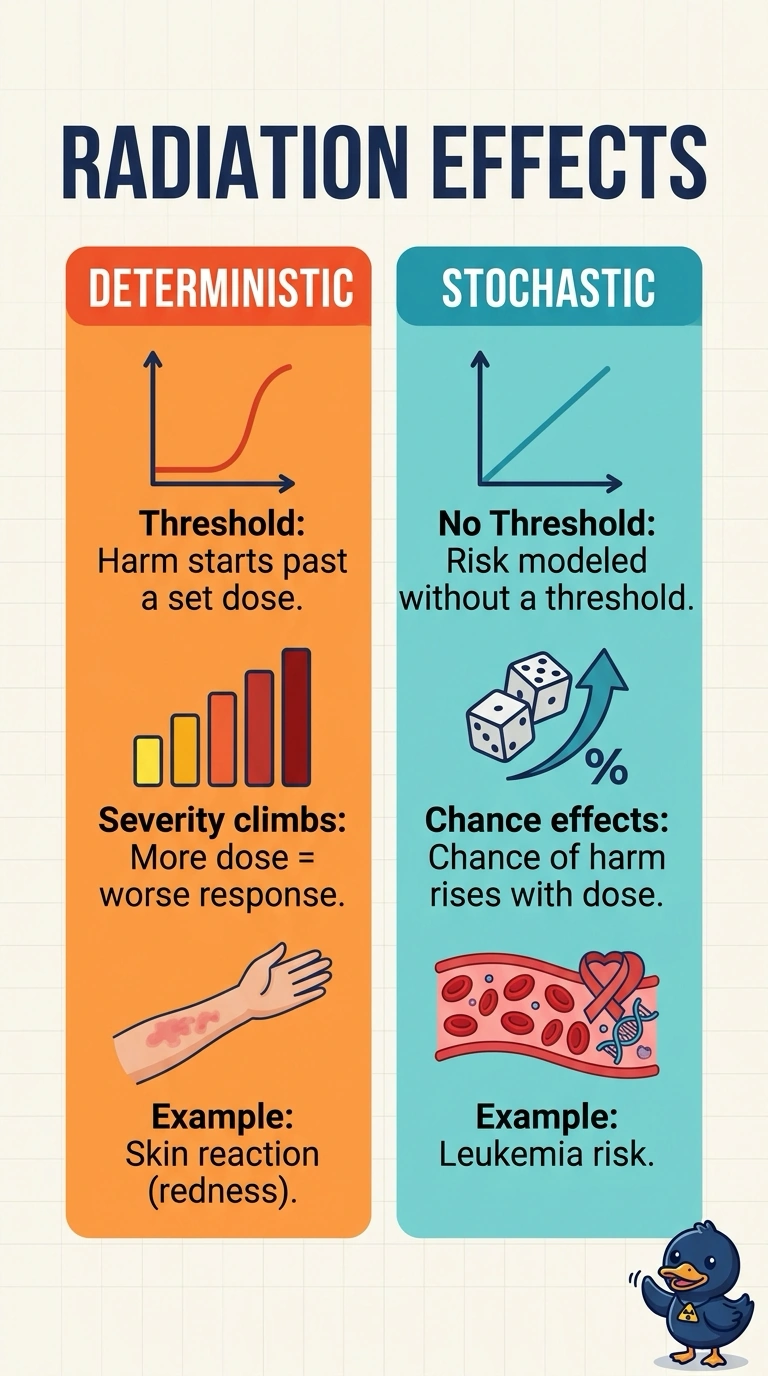
You're sorting these outcomes by how dose relates to effect, and the two rules differ. A deterministic effect needs a threshold and gets worse with more dose, like a sunburn after too much sun. The leukemia risk, though, is chance-based with no threshold, and it is a somatic risk rather than one passed to offspring.
Full Explanation
Radiation effects split by the relationship between dose and outcome, and that rule decides the answer. A deterministic effect has a threshold below which it does not appear and above which severity climbs with dose, so the brisk skin reaction during a pelvic course fits this pattern because erythema builds predictably as the fractionated dose accrues. A stochastic effect has no threshold and instead shows a probability that rises with dose, so radiation-induced leukemia is a chance event rather than an injury destined to happen. The swapped-label pairing fails because it reverses those dose-response rules and would make the skin reaction threshold-free while making the leukemia deterministic. The both-deterministic pairing fails because it ignores probability-only behavior and would imply a safe dose exists below which cancer cannot occur. The heritable-genetic pairing fails because it confuses a somatic effect in the patient's own cells with a germ-cell effect that would pass to children. An exam caveat is that older sources still call deterministic effects nonstochastic, so recognize both terms. As a practical check, ask whether the stem describes severity changing with dose or probability changing with dose.