
A patient with a right upper lobe lung tumor is being staged, and the physician reviews the usual regional nodal drainage from this tumor location before planning the target volumes. Which nodal group is the best answer for the first-echelon regional drainage?
Select an answer to reveal the explanation.
Short Explanation
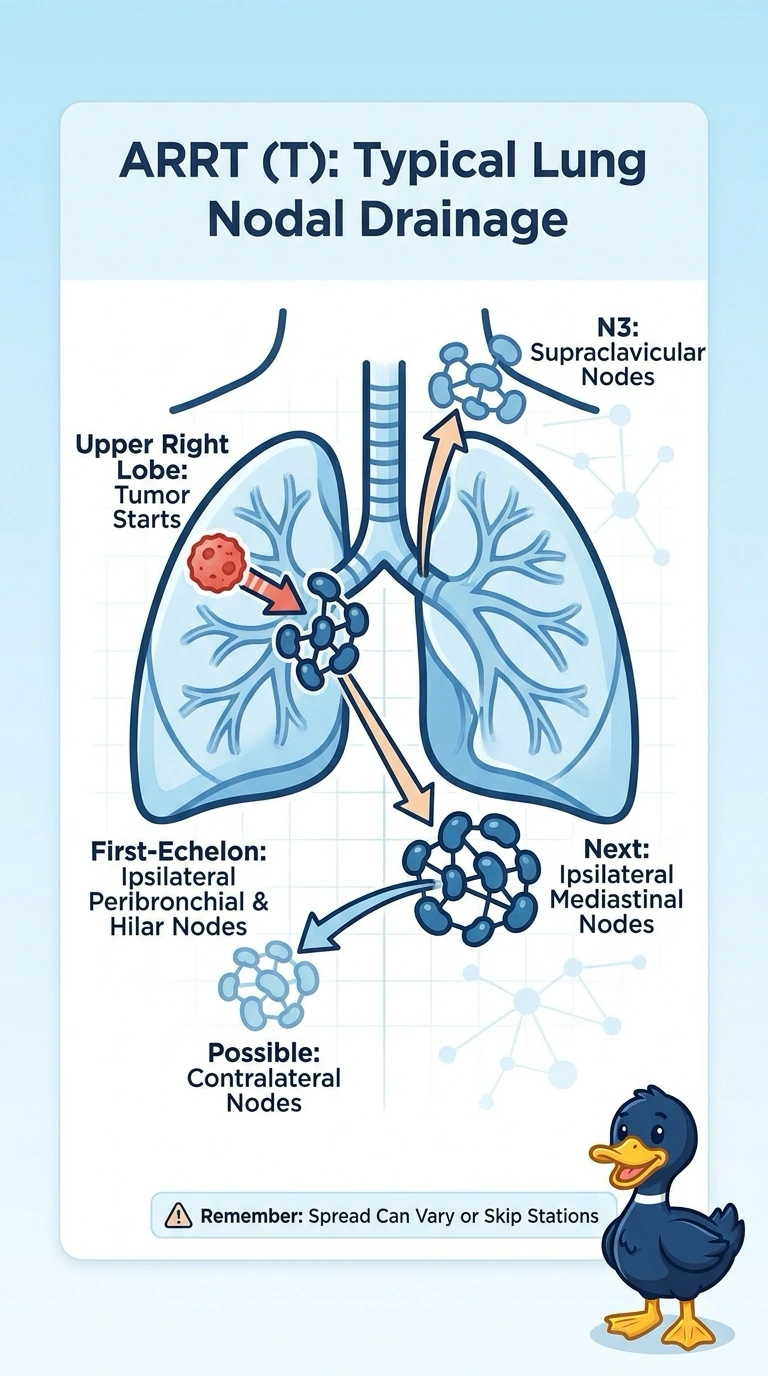
For a right upper lobe tumor, the first stop along the lymphatic drainage route is usually the ipsilateral peribronchial and hilar nodes. You can think of these as the nearest checkpoints for drainage from the tumor.
Full Explanation
For a right upper lobe tumor, the usual first-echelon regional nodes are the ipsilateral peribronchial and hilar nodes (N1). Lymph from the lung commonly travels through intrapulmonary and peribronchial channels toward the ipsilateral hilum before reaching more central mediastinal stations, making these nodes the expected initial regional group. The “direct-to-mediastinum” approach is not the usual drainage pattern: ipsilateral mediastinal nodes (including subcarinal nodes) are classified as N2 and are generally downstream of N1. The “cross-midline-first” approach also fails because contralateral hilar nodes are not the typical initial basin and are classified as N3. Likewise, treating the ipsilateral supraclavicular nodes as the earliest basin confuses a more distant nodal site with the usual first-echelon drainage; supraclavicular involvement is classified as N3. Exam caveat: this describes a typical pathway, not an obligatory sequence—lymphatic drainage and metastatic spread vary, and skip metastases can occur. Practical check: review the nodal stations on imaging and apply the staging criteria in use rather than inferring involvement solely from the primary tumor’s location or assuming orderly spread.