
A patient who has completed several weeks of daily treatments sits up from the couch and reports the room spinning. The therapist notes pale skin, a pulse of 104 taken while the patient stands, and that the patient drank very little fluid overnight, while last week's readings were unremarkable. Which measurement sequence should the therapist obtain to assess for an orthostatic blood pressure change?
Select an answer to reveal the explanation.
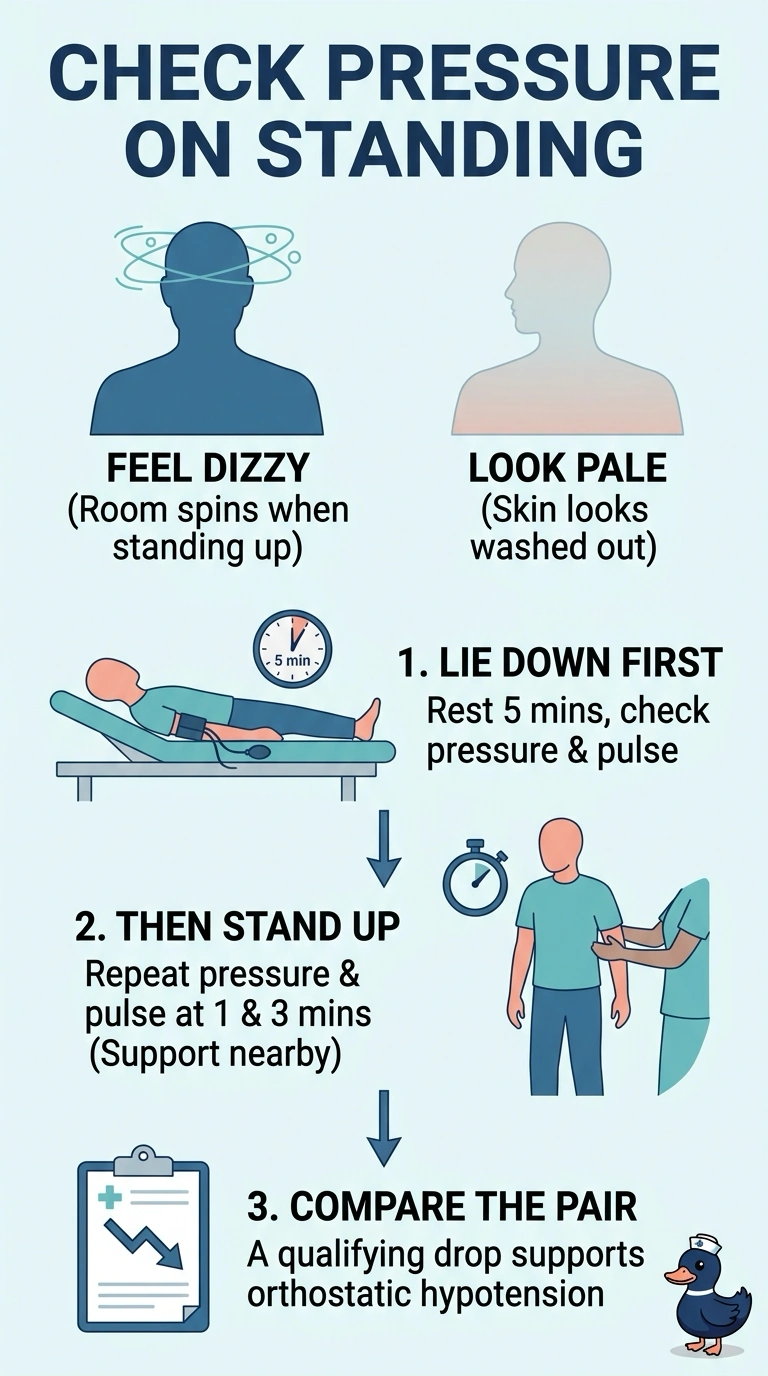
Short Explanation
You’re checking a before-and-after snapshot: after your patient rests lying down for five minutes, take their blood pressure and pulse, then repeat both at one and three minutes after they stand, with support nearby. A qualifying blood pressure drop supports orthostatic hypotension, but it doesn’t prove that’s what caused the dizziness.
Full Explanation
Dizziness after standing, pallor, a standing pulse of 104, and very little fluid intake make an orthostatic change worth assessing. After the patient rests supine for five minutes, measure blood pressure and pulse, then repeat them at one and three minutes after standing, keeping the patient supported. Orthostatic hypotension is generally defined as a sustained fall of at least 20 mm Hg systolic or 10 mm Hg diastolic within three minutes of standing. Such a finding supports orthostatic hypotension but does not by itself establish the cause of the dizziness. A seated repeat may not reveal a change caused by standing. Comparing weekly weights can help assess fluid status, but it does not test for a positional blood pressure change. Checking capillary refill, temperature, and respiratory rate may be useful in other assessments but does not test for that change.