
During orientation, a student reads four course descriptions from the schedule: a larynx photon plan, a total skin electron course for cutaneous lymphoma, a total body irradiation conditioning plan, and a temporary implant left in a cavity overnight. Which statement correctly matches each technique to its treated volume and where its source sits?
Select an answer to reveal the explanation.
Short Explanation
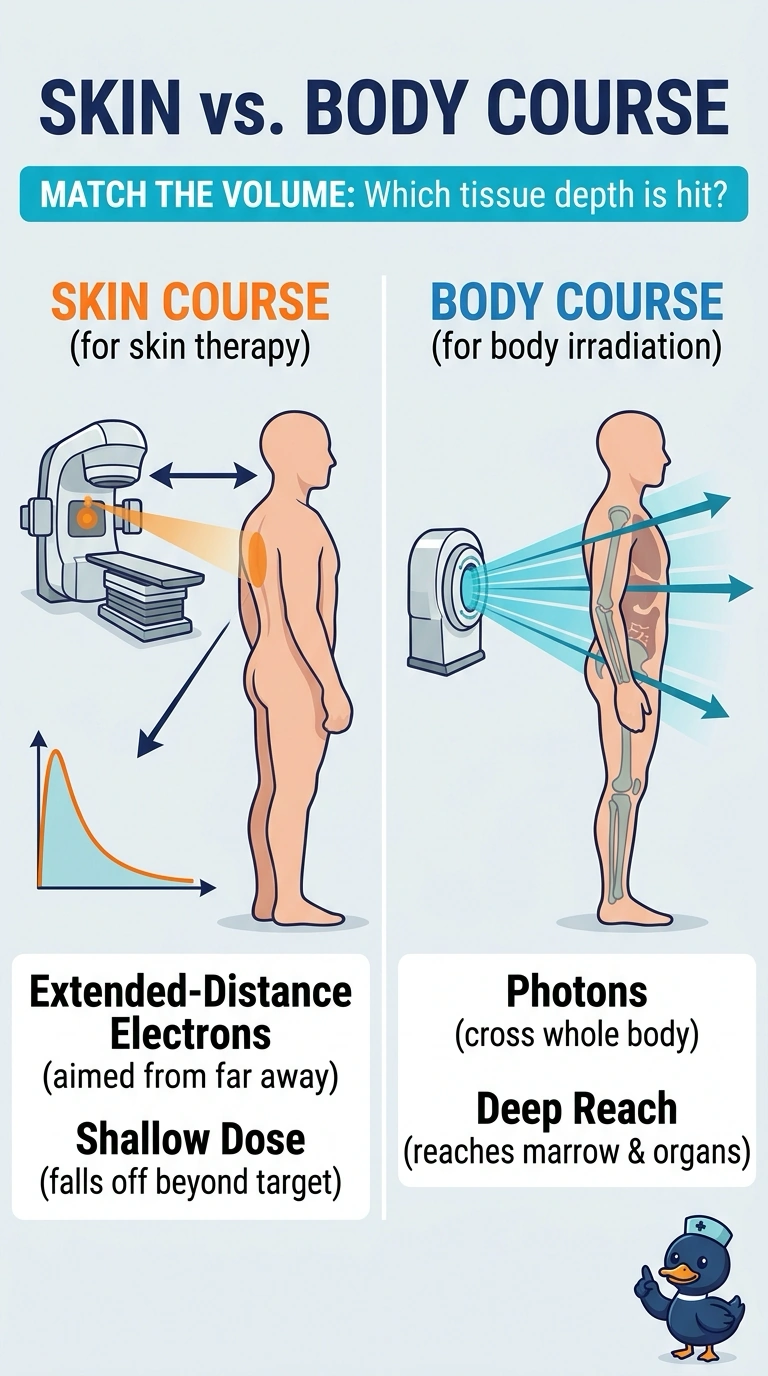
You can match the larynx with external photons, the cavity implant with an internal source, skin therapy with extended-distance electrons, and body irradiation with photons treating the whole body. Skin electrons deliver dose near the surface, while photons can cover the whole patient; the treated volume is your tell, not just the machine name.
Full Explanation
The correct description matches each technique to its delivery method and treatment volume: external-beam photons treat the larynx, a temporary internal source in a cavity provides intracavitary brachytherapy, extended-distance electrons cover the skin surface in total skin electron therapy, and photons can treat the whole body for conditioning. Describing body irradiation as treatment of only the marrow-bearing axial skeleton instead gives a targeted volume, not the whole-body volume required for total body irradiation. Describing skin therapy as treatment of involved patches limits the target to localized disease rather than the skin surface addressed by total skin therapy. Placing the implant source within tissue adjacent to the cavity describes interstitial brachytherapy, whereas the stated temporary cavity implant is intracavitary. A useful exam caveat is that related treatments may use similar beams or equipment yet differ in prescribed target volume and source geometry. For a practical check, confirm the treatment site and extent, radiation modality, setup distance, and whether the source is external, intracavitary, or interstitial in the plan or procedure record.