
A patient scheduled for MRI simulation before pelvic radiotherapy reports that he once ground steel without eye protection and may have had a spark reach his eye. He denies eye pain, sees normally, and his questionnaire shows no implants, pacemakers, or retained metal anywhere else. Which screening step must be completed before he is allowed into the magnet room?
Select an answer to reveal the explanation.
Short Explanation
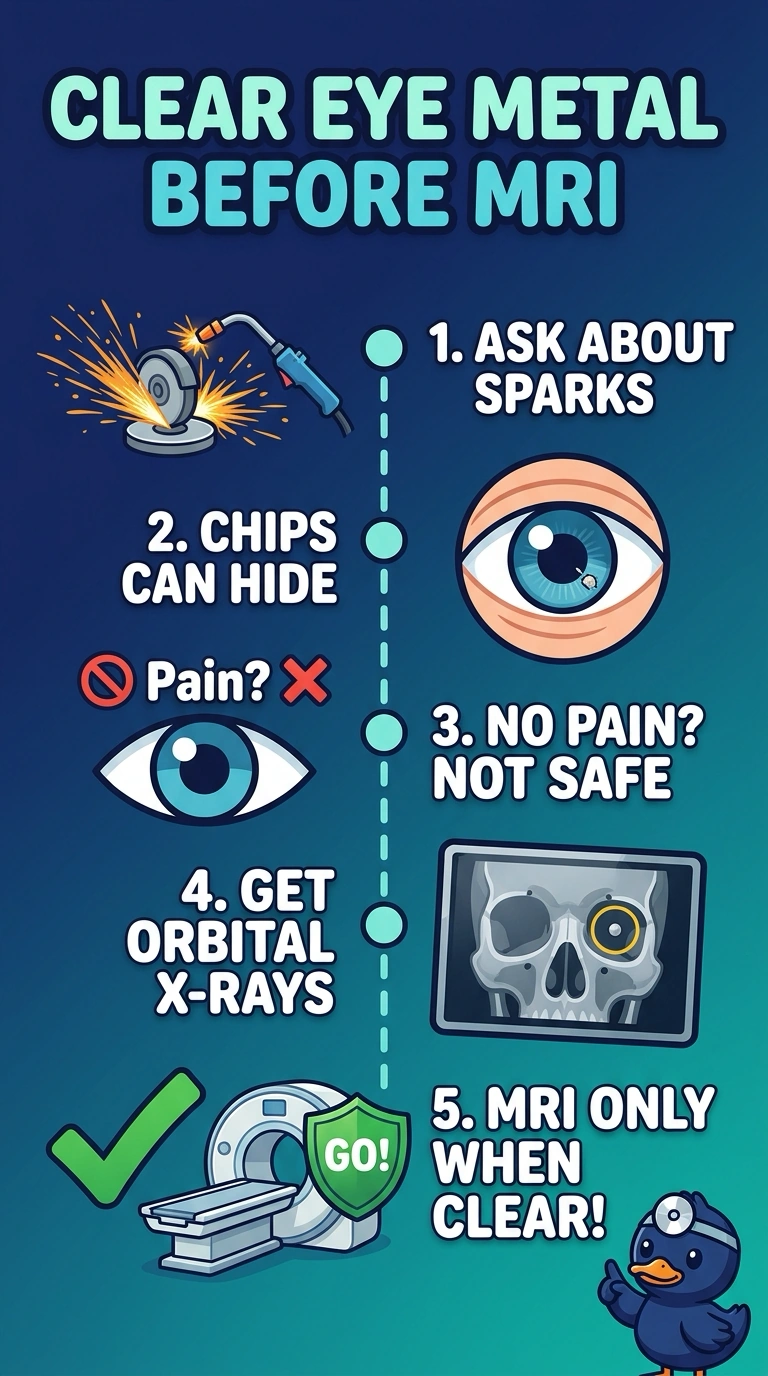
Even when you feel well and see normally, a tiny steel fragment may remain near the eye. You should obtain orbital x-rays to rule it out before entering the magnet room.
Full Explanation
A spark from grinding steel raises concern for a retained metallic fragment in or around the eye. Such a fragment may move or heat in the magnetic field, so you need to resolve this history before the patient approaches the magnet; normal vision and no pain do not reliably exclude a small fragment. Orbital x-rays are the indicated screening step and should be reviewed before magnet-room access. Visual-acuity and slit-lamp examinations can identify some eye problems, but normal results do not reliably rule out a retained fragment. A handheld ferromagnetic detector may assist with screening, but a negative signal cannot reliably exclude a small or deeply located orbital fragment and does not replace the indicated x-rays. Repeating the MRI safety questionnaire may help identify other hazards, but it cannot resolve the reported possibility of eye exposure; no other reported metal does not remove that concern. Exam caveat: distinguish the need to rule out a fragment from the reassuring findings of a normal eye examination or questionnaire. Practical check: confirm that the orbital x-rays have been interpreted and documented as negative before authorizing entry into the magnet room.