
During a chart review you find a four-field pelvic plan prescribed to 60 Gy at the isocenter, with beam weights listed as AP 0.4, PA 0.4, right lateral 0.1 and left lateral 0.1. The physicist notes that every weight is referenced to the isocenter dose. Which statement correctly describes what these weights control in the plan?
Select an answer to reveal the explanation.
Short Explanation
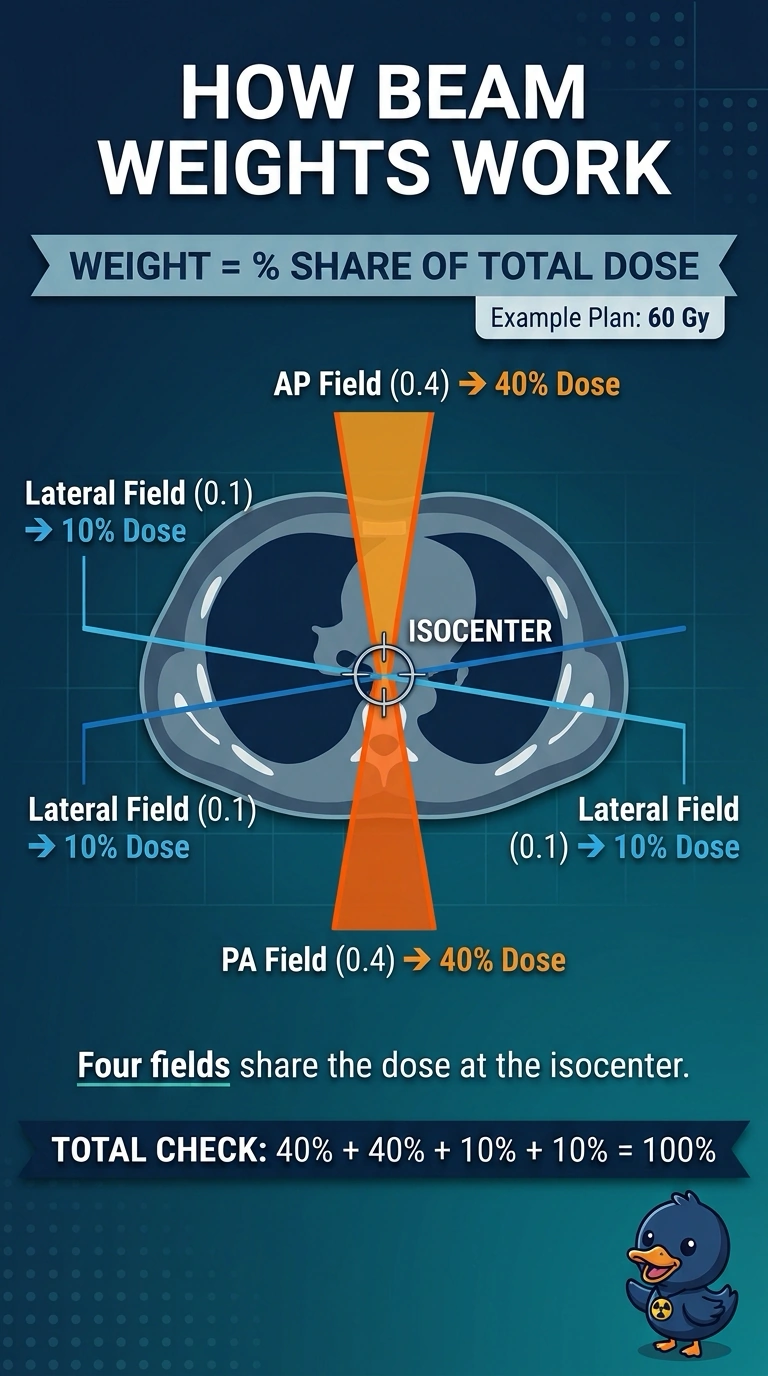
You can read each beam weight as that field’s percentage of the dose at the isocenter, rather than as a schedule or timer. Think of it like splitting a bill: each field contributes its share of the total, whatever the treatment time.
Full Explanation
Each beam weight specifies that field’s share of the dose at the isocenter. The AP and PA fields therefore each contribute 40% of the isocenter dose, while the right and left lateral fields each contribute 10%; together, the four contributions total 100%. These percentages do not describe each field’s share of the target’s mean dose, which is a different quantity from dose at a specified point. Nor do the weights mean that the fields receive relative monitor units of 0.4 and 0.1: monitor units depend on beam calibration and geometry and are not interchangeable with dose fractions at the isocenter. Finally, the percentages do not refer to the plan’s maximum dose, which need not occur at the isocenter. Exam caveat: beam-weight conventions can vary by treatment-planning system, so do not infer the reference quantity from the word “weight” alone. Practical check: verify the plan’s normalization or reference-point definition and inspect each field’s calculated contribution at the isocenter.