
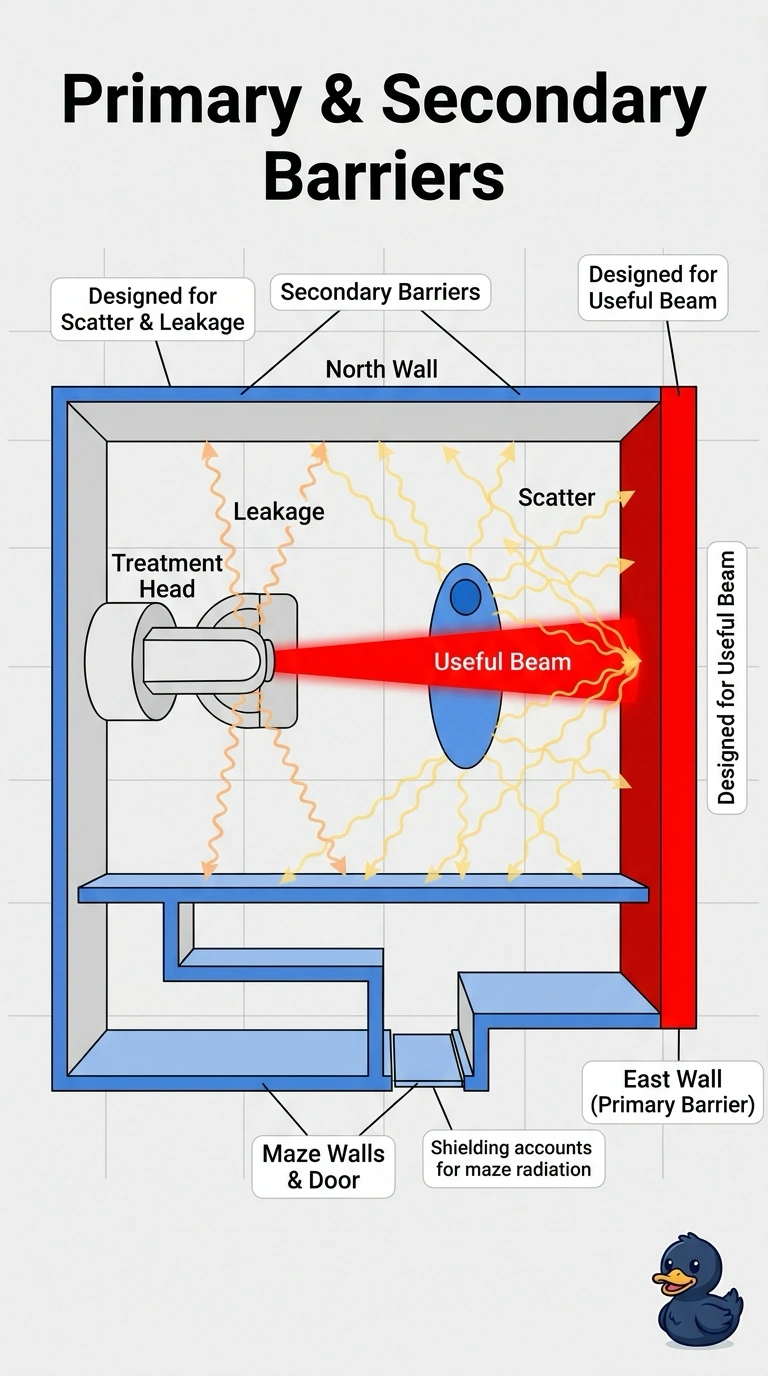
During a review of a new treatment vault, the architect points out three areas: an east wall that can be struck by the useful beam at gantry 90°, a north wall several meters from the couch that never crosses the beam path, and a maze wall seen only around a corner from the target. Which classification correctly identifies the shielding basis for each area?
Select an answer to reveal the explanation.
Short Explanation
You can identify the east wall as a primary barrier because the useful beam can strike it. The north and maze walls are secondary barriers, designed for scattered and leakage radiation.
Full Explanation
The east wall can intercept the useful beam at gantry 90°, so it is a primary barrier designed for direct-beam exposure. The north wall is outside the beam path, and the maze wall is around a corner from the target; both are secondary barriers designed for the applicable combination of patient or room scatter and treatment-head leakage. Describing the east wall as primary but saying leakage is not checked there is incomplete: its shielding must address the direct beam, and leakage must also be assessed to determine whether it affects the required thickness. Treating the north wall as leakage-only is also incorrect because being outside the beam does not eliminate scattered radiation. Likewise, the maze corner prevents direct-beam exposure but does not eliminate scatter, so a leakage-only basis is insufficient. Exam caveat: primary and secondary identify the radiation basis for shielding, not a guarantee that only one radiation component contributes to final barrier thickness. Practical check: verify the approved workload, use factors, beam orientations, occupancy, and maze geometry in the site-specific shielding calculation, including scatter and leakage where applicable.