
During a physics review, a photon beam and a neutron beam are compared: the neutron beam kills the same cells at a lower physical dose and shows a smaller increase in cell kill when oxygen is added. Which radiobiologic principle explains the neutron beam's higher effectiveness?
Select an answer to reveal the explanation.
Short Explanation
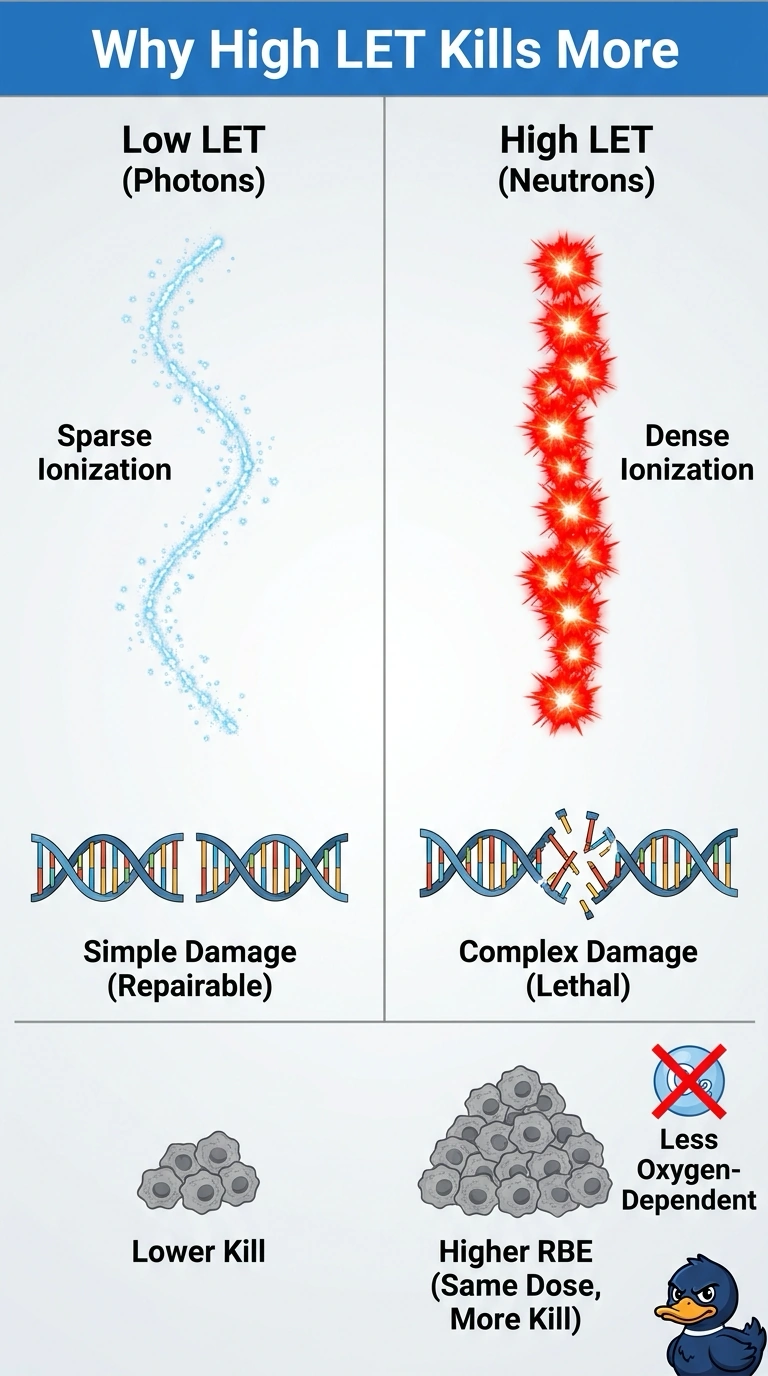
Your clue is high-LET: neutrons deposit energy in dense tracks that cause complex DNA damage, giving them a higher RBE than photons and making cell kill less dependent on oxygen. It’s like a few heavy punches landing together rather than many light taps.
Full Explanation
Linear energy transfer describes how much energy a beam deposits along each unit of track, and track density influences biological effect: high-LET radiation produces clusters of ionization that cause complex DNA damage, which is less dependent on oxygen to become permanent than much low-LET damage. Thus, high-LET radiation generally has a lower oxygen enhancement ratio and a higher RBE than low-LET radiation, although both values depend on the radiation, dose, tissue, and endpoint. That explains why the neutron beam kills at a lower dose and why adding oxygen changes its effect less. The low-LET claim fails because sparse ionization can damage DNA indirectly through free-radical reactions; oxygen can make this damage more permanent, so low-LET beams generally show a larger oxygen effect. The oxygen-dose claim reverses the oxygen effect, since oxygen generally makes cells more radiosensitive and lowers the dose needed for a given level of cell kill. The intrinsic-sensitivity claim fails by category, because cell-cycle activity and oxygenation describe how a cell population responds, while RBE compares biological effects of different radiation types at a specified endpoint and dose. RBE is not a fixed constant and varies with factors such as dose per fraction, tissue, and endpoint. A practical check is to ask which reference radiation and biological endpoint produced any RBE value you are given.