
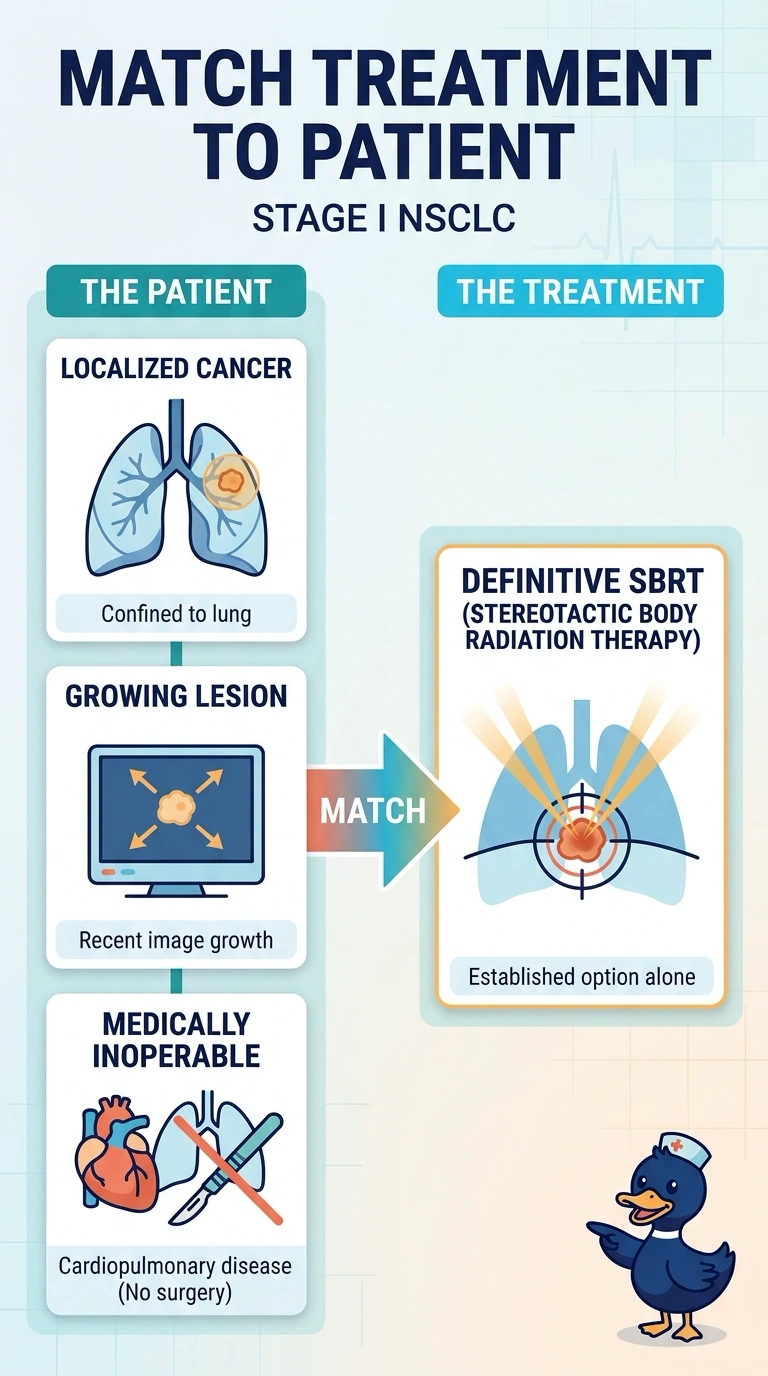
A patient with a small, localized stage I non-small-cell lung cancer that has grown on recent imaging is medically inoperable because of cardiopulmonary disease. Which management approach best fits this patient's tumor and medical fitness?
Select an answer to reveal the explanation.
Short Explanation
Because the tumor is growing, continued monitoring isn’t the best fit, and your cardiopulmonary disease makes surgery unsafe. Definitive SBRT alone can treat the localized cancer, like aiming a precise beam right at the problem.
Full Explanation
Definitive SBRT alone is the best fit: it delivers an ablative radiation dose to a small, localized stage I tumor while avoiding the cardiopulmonary risks of surgery. The documented growth also supports treating the cancer rather than observing it. Conventionally fractionated radiation can be used for medically inoperable lung cancer when SBRT is unavailable or unsuitable, but no such limitation is given; for a small localized tumor, SBRT is the more appropriate definitive radiation approach. Concurrent platinum-based chemoradiation is commonly used for locally advanced disease, where systemic and regional treatment are warranted, but it adds toxicity without an established role for this stage I tumor. Active surveillance may be reasonable for selected indolent lesions or patients whose competing risks outweigh treatment benefit, but recent growth argues against assuming this cancer will remain stable. Exam caveat: SBRT is preferred for many medically inoperable patients with early-stage NSCLC, but tumor location, size, prior radiation, and organ-at-risk constraints can change the radiation plan. Practical check: confirm staging and review the diagnostic imaging with radiation oncology to verify that the lesion is suitable for SBRT and that normal-tissue dose constraints can be met.