
During a routine output check, a therapist measures an ion chamber in air at 100 cm from the source, then moves the same chamber to 150 cm with the beam and every machine setting unchanged. The physicist asks the therapist to predict the new reading before it is recorded. Which reading should the therapist expect from the inverse square relationship at 150 cm?
Select an answer to reveal the explanation.
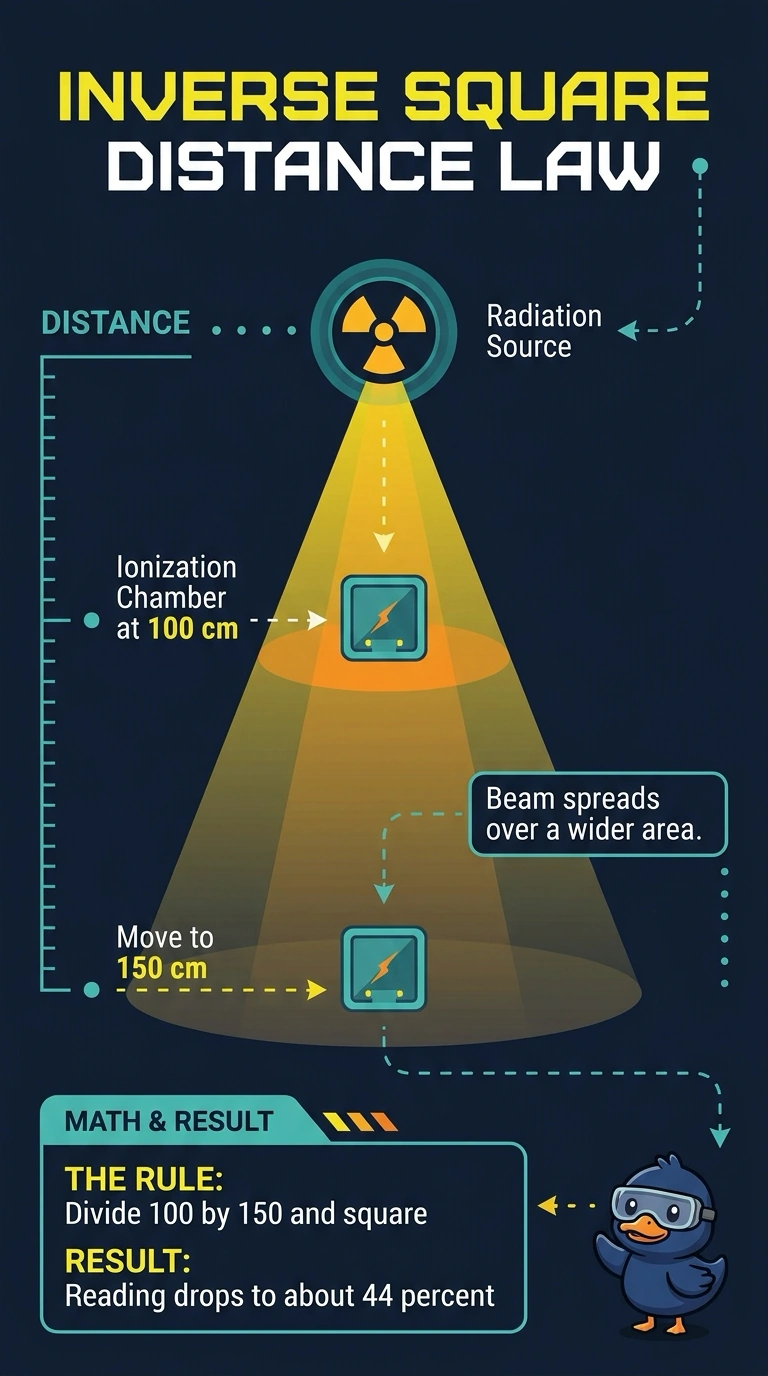
Short Explanation
Moving the chamber out spreads the same beam over a wider area, and intensity falls with the square of the distance instead of the distance alone. Divide 100 by 150, square that ratio and you'll land on about 44 percent of the first reading. That's the inverse square law showing up in one of your simplest daily checks.
Full Explanation
A photon source spreads its energy over a sphere whose surface area grows with the square of the radius, so intensity measured in air is proportional to one over distance squared. Taking 100 cm as the reference, dividing by 150 cm and squaring gives about 0.44, so the chamber should report roughly 44 percent of its first reading. Treating the falloff as a simple inverse proportion describes a linear decline and lands near 67 percent, a classic first-power error that ignores the three-dimensional spreading of the beam. Holding the reading steady because air attenuation across 50 cm is tiny applies a true physical fact to the wrong mechanism, since geometric spreading dominates while air absorption at treatment energies is negligible over that short path. Scaling the drop for a doubling of the cross-sectional area underestimates the geometry, because area grows with the square of the distance and the factor at 150 cm is 2.25 rather than 2. One exam caveat: when the detector sits in a phantom instead of air, depth, scatter and beam quality also shape the reading, so the pure inverse square estimate applies to geometry alone. Practical check: before recording an unexpected value, confirm the measured distance and the reference distance used for the last comparison.