
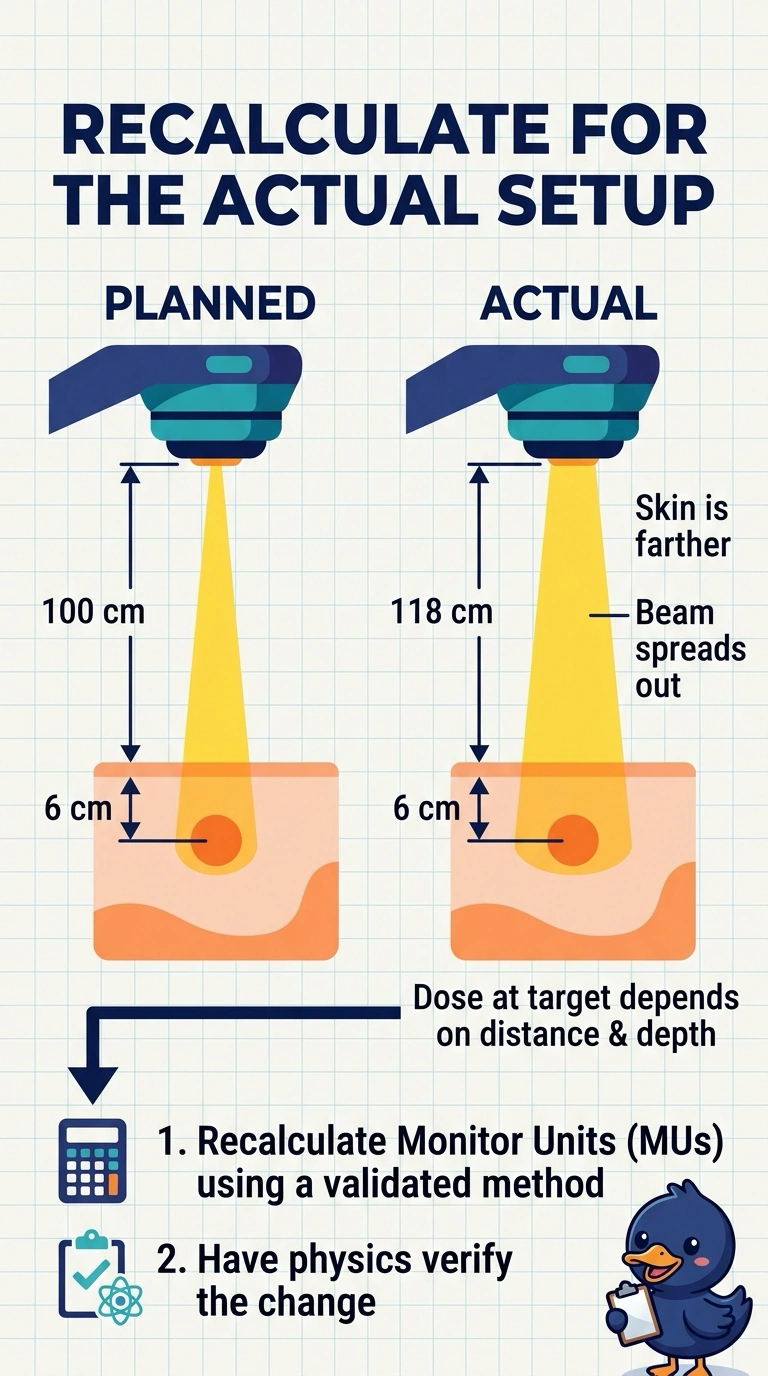
The linac is calibrated for a 100 cm source-to-skin distance, but a thick immobilization vest places this patient's skin at 118 cm for a target that sits on the central axis at 6 cm depth. Monitor units were copied unchanged from a nominal-distance plan. What should the physicist do before treatment?
Select an answer to reveal the explanation.
Short Explanation
Your dose per monitor unit depends on more than the inverse-square change in skin distance—it’s like adjusting a recipe when several ingredients have changed. Before treatment, recalculate the monitor units with a validated method that accounts for the actual distance, depth, and field geometry.
Full Explanation
The copied monitor units cannot be assumed valid: the skin is 18 cm farther from the source than the 100-cm calibration distance, and the target lies 6 cm beneath the skin. Recalculate with a validated method representing the actual source-to-target distance, target depth, and field geometry. Applying extended-SSD inverse-square and 6-cm depth-dose corrections while retaining the nominal-field output factor does not account for the changed field dimensions and their effect on output. Applying the extended-SSD inverse-square correction and projected-field output factor while retaining the nominal-depth dose factor does not represent the target’s actual depth. Applying the measured 6-cm depth-dose value and projected-field output factor while retaining the nominal-SSD inverse-square term neglects the changed source-to-target distance. Exam caveat: extended-SSD calculations and output factors depend on the beam, field definition, and commissioning data, so a generic correction formula is not automatically valid. Before treatment, verify the measured SSD, target depth, and field geometry against the plan, then independently check the recalculated MU using the department’s approved method.