
During a consultation, a patient whose mother and sister both had breast cancer asks why she was told to begin screening earlier than friends of the same age. You want to document the discussion accurately for the record. Which explanation of cancer risk factors fits her situation?
Select an answer to reveal the explanation.
Short Explanation
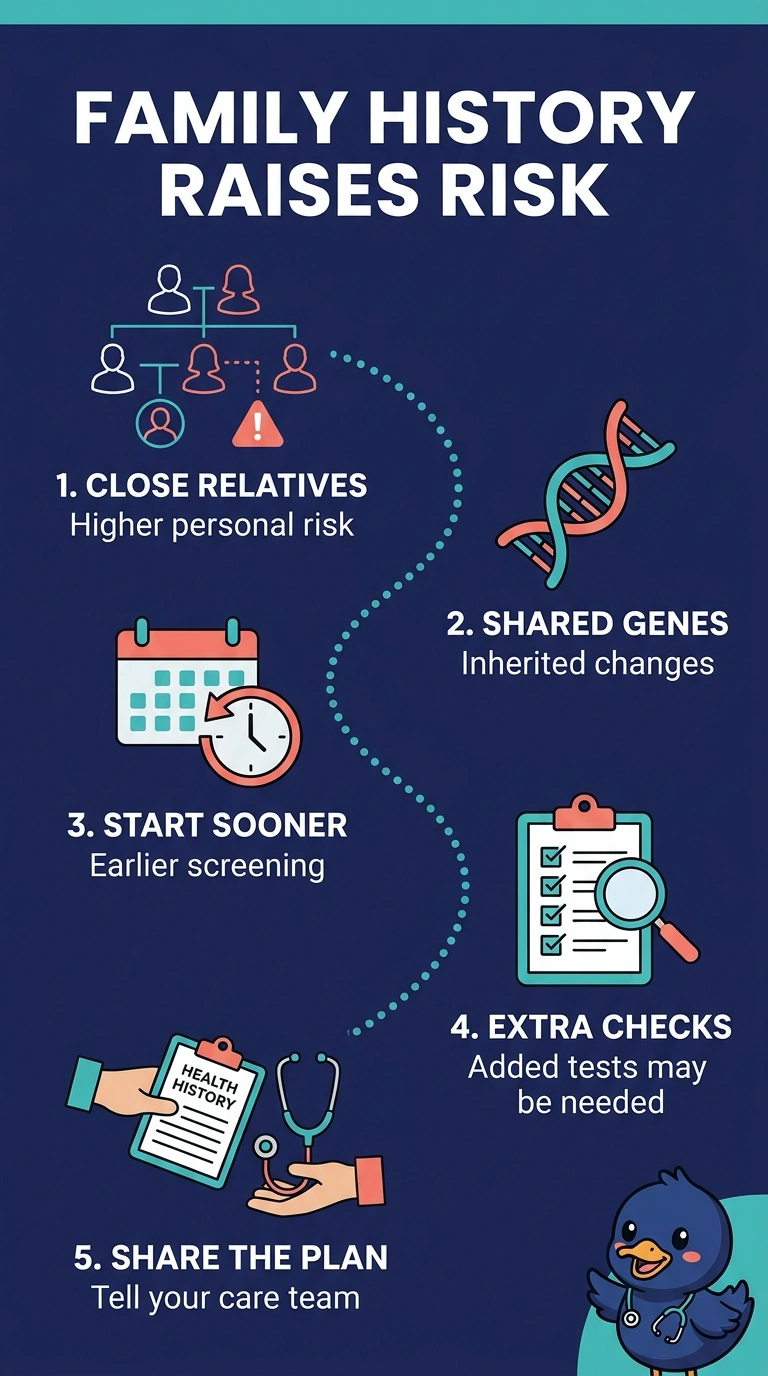
Two close relatives with the same cancer can point to an inherited tendency, so you'd explain why her screening starts earlier than average. Risk like this stacks up on a family tree, and it's a risk factor worth acting on.
Full Explanation
Cancer risk factors are grouped as inherited, environmental, and lifestyle influences, and a mother plus a sister with the same cancer marks a strong familial signal, because inherited changes in growth-regulating genes can be passed down and raise lifetime susceptibility; screening advice responds by starting sooner or adding imaging for that group. Selecting age alone ignores the familial component that prompted the earlier recommendation in the first place, since age describes background risk rather than this patient's family clustering. Limiting assessment to lifestyle factors excludes the strongest determinant here, because diet and activity do not explain the same cancer appearing across two generations. Returning her to average risk after one benign biopsy misstates the model, since benign tissue does not erase an inherited predisposition and risk is reassessed over time. Exams usually test why risk categories matter rather than a specific age or interval, because those thresholds vary between guidelines. A practical check: record the relatives involved, their degree of relation, and the date obtained, then confirm the plan the clinician ordered.