
A 6 MV beam treats a mediastinal target through a physical wedge, a tray-mounted block, and chest wall bolus, with the wedge and tray output factors already applied. An ion chamber beyond a low-density lung region, where primary-beam transmission dominates, reads higher than the homogeneous water calculation predicts. Which dose calculation factor explains the higher reading?
Select an answer to reveal the explanation.
Short Explanation
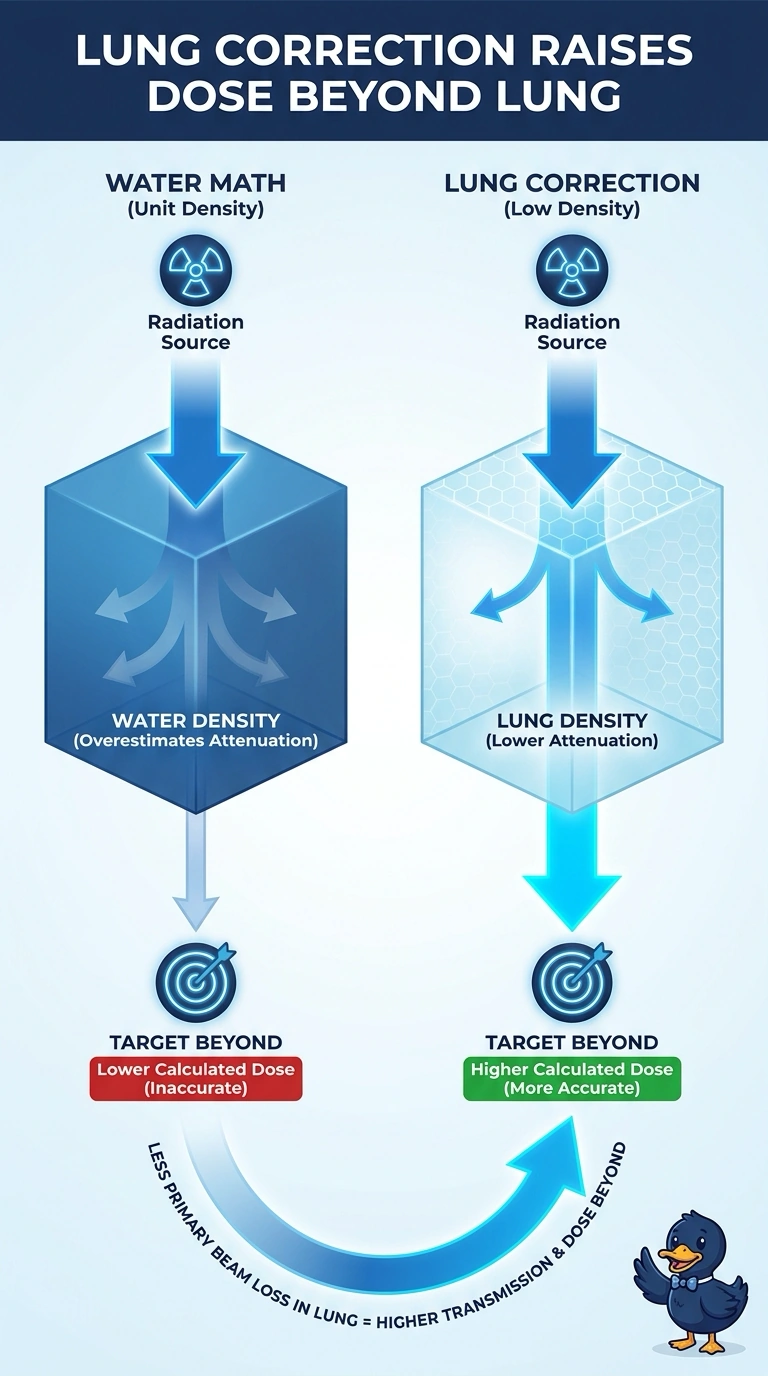
The homogeneous water calculation treats the lung path like a thicker filter than it really is. Your lung inhomogeneity correction accounts for the reduced attenuation, like light passing through a thinner curtain, and raises the calculated dose beyond the lung; the wedge, tray, and bolus aren’t the cause here.
Full Explanation
A homogeneous-water calculation assumes a unit-density path, whereas low-density lung attenuates less primary radiation. Beyond the lung, where primary-beam transmission dominates, more intensity can therefore reach the chamber than the water calculation predicts, and a lung inhomogeneity correction can raise the calculated dose. The size and even direction of a heterogeneity effect depend on location, geometry, and the dose-calculation algorithm; scatter and electron disequilibrium can matter, particularly in or near lung. The wedge output factor and tray attenuation factor are already applied in this scenario, so neither explains the discrepancy. Bolus affects dose near the surface and can alter dose at depth, but it does not account for the stated transmission difference through lung. As a check in a calculation where reduced primary attenuation is the dominant effect, overriding the lung to unit density should lower the calculated dose beyond it.