
A patient with a superficial chest wall lesion is planned for photon treatment, and the physician wants the dose at the skin surface to reach the prescription level instead of falling in the build-up region. Which beam modifier should be added to the treatment set-up for each fraction?
Select an answer to reveal the explanation.
Short Explanation
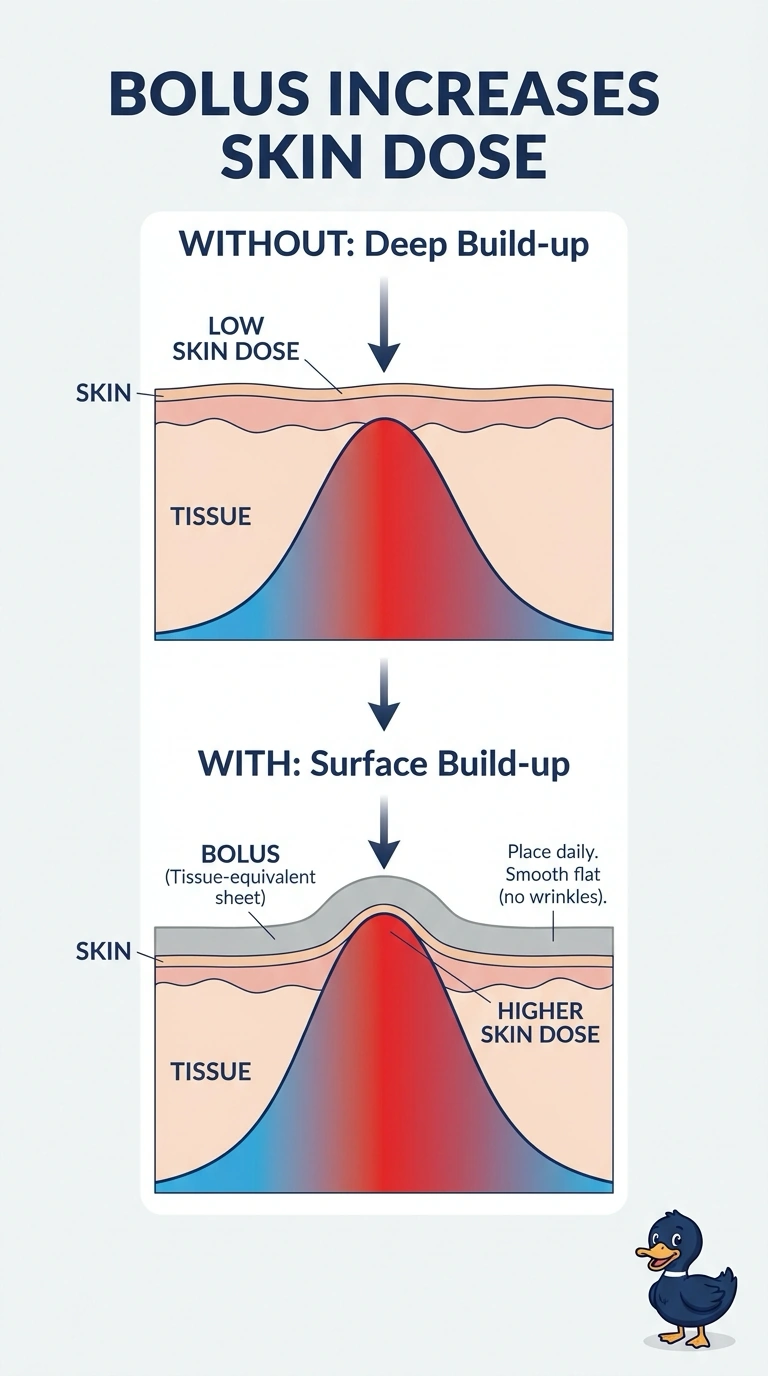
Add a bolus to the skin for each treatment; it shifts the build-up region toward the surface so your skin receives the prescribed dose. It works like adding a tissue-equivalent layer between the beam and your skin.
Full Explanation
In a megavoltage photon beam, dose builds up over the first centimetre or so as secondary electrons are set in motion, so the skin sits below the depth of maximum dose and receives less than the dose at that depth. Bolus places tissue-equivalent material in front of the skin, moving the build-up region into the bolus and increasing the dose at the skin. The bolus thickness is selected to achieve the prescribed dose. A wedge redistributes intensity across the beam to compensate for oblique incidence or a sloping contour, but it does not shift depth dose toward the surface. An MLC shapes the beam laterally to match the target border, so the field edge improves while surface dose is not the intended effect. Choosing a lower megavoltage photon energy shortens the depth of maximum dose, yet the skin still lies above it and target penetration falls as well. Exam caveat: bolus thickness and material follow the physician's order, and added bolus can also raise the skin reaction the patient feels. Practical check: confirm the bolus thickness on the plan and lay it smoothly against the skin without wrinkles or air gaps each fraction.