
During a physics in-service, a resident compares two beams delivering the same absorbed dose to a tumor and asks why the neutron beam kills more cells than the megavoltage photon beam. Which beam property accounts for the greater biological effect at equal dose?
Select an answer to reveal the explanation.
Short Explanation
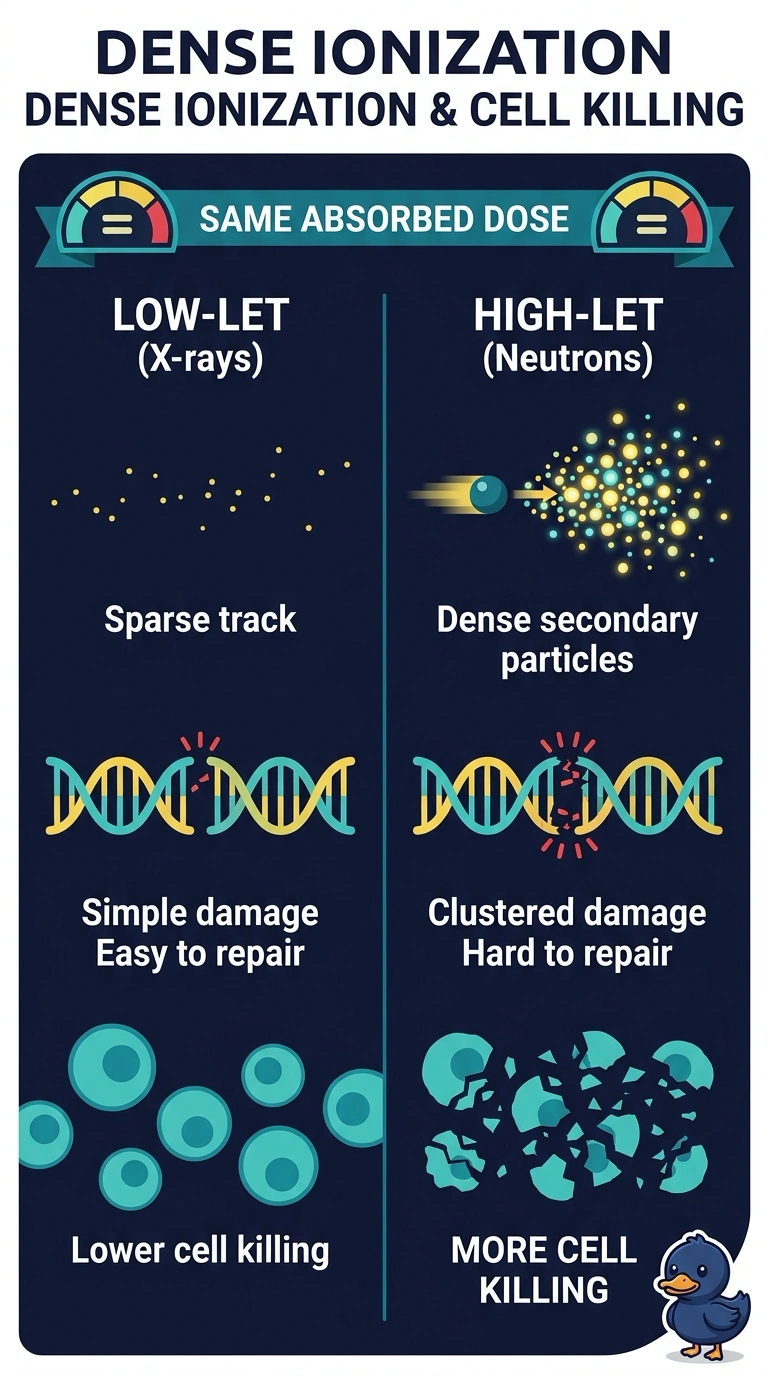
You can picture neutron damage as a tightly packed trail rather than scattered hits. Their high-LET secondary particles create dense ionizations and complex DNA damage that is harder for cells to repair than damage from megavoltage photons.
Full Explanation
Linear energy transfer (LET) describes energy deposited per unit track length. Neutrons interact indirectly by producing secondary charged particles, some of which have high LET and create densely clustered damage that is harder for cells to repair than damage typically caused by megavoltage photons. This is the beam-quality property that explains greater cell killing at the same absorbed dose. Faster dose delivery is not the explanation: the total absorbed dose is already matched, and dose rate does not replace the role of radiation quality in this comparison. Indirect action through free radicals occurs with both low- and high-LET radiation, although its relative contribution varies with radiation quality; it does not account for the greater neutron effect here. A greater oxygen enhancement effect is also not the explanation, since oxygen generally enhances low-LET radiation more than high-LET radiation. As an exam caveat, the precise biological effect depends on the neutron spectrum, dose, tissue, and endpoint, so high LET is the relevant general explanation rather than a guarantee of the same effect in every setting. As a practical check, confirm that absorbed doses are equal, then identify the radiation quality that produces dense, difficult-to-repair damage.