
A new course of external beam treatment is ready to start, but the signed prescription lists only the total dose and fractionation schedule, and the record-and-verify entry shows a generic anatomic region instead of a specific site. Before the first fraction, which verification step confirms the treatment site?
Select an answer to reveal the explanation.
Short Explanation
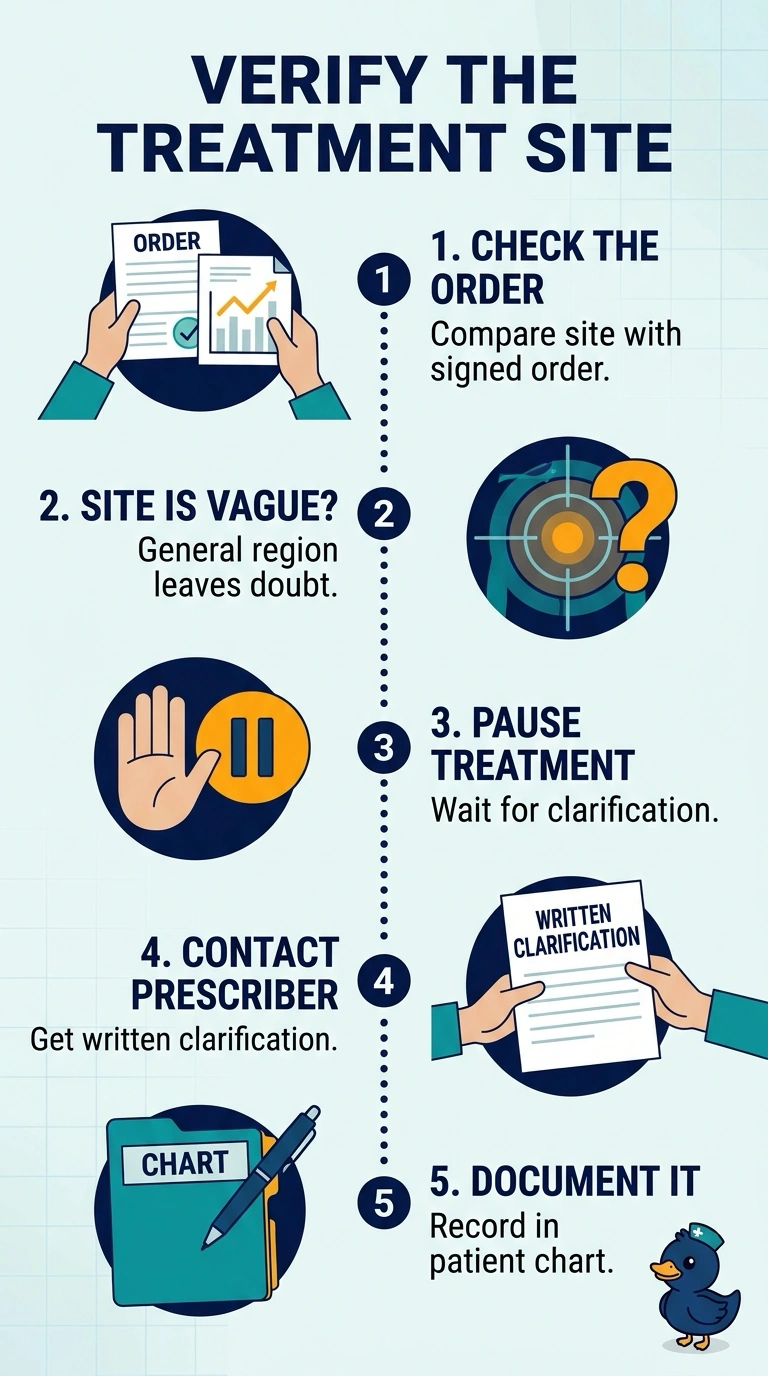
When the treatment site is vague, you can’t fill in the blank by guessing—it’s like needing the right address before a delivery. Before the first fraction, you need written clarification from the authorized prescriber naming the site; identity checks and image review don’t replace it.
Full Explanation
When the signed prescription does not identify a specific treatment site, the therapist must hold treatment and obtain written clarification from the authorized prescriber. The prescriber is responsible for specifying the intended site; written clarification resolves the ambiguity in the treatment order rather than relying on an assumption. Patient-identification checks confirm that the correct person is present, but matching an identification band and appointment time to the daily schedule does not establish where that person is to be treated. Patient self-report is also not a substitute for an authorized prescription: a patient may misunderstand or misremember the plan, and recording the response does not make it an authorized treatment instruction. Inferring the site from planning images or target annotations is likewise inappropriate; those materials may give context but do not replace clarification of an incomplete prescription. Exam caveat: do not confuse a correct patient check or plausible imaging interpretation with confirmation of the prescribed site. Practical check: before the first fraction, compare the clarified site, total dose, and fractionation schedule in the prescription with the record-and-verify entry; resolve any mismatch before delivering treatment.