
During commissioning of a linear accelerator vault, a calibrated survey at an accessible position 30 cm from the maze entrance measures a dose equivalent rate of 40 mrem per hour while the beam is on, and the outer corridor beyond the maze stays below 0.05 mrem per hour. Staff can reach that entrance mid-treatment if the door interlock is bypassed. Under the federal radiation-area criterion, what classification and posting apply, and what controls should this site use at the entrance?
Select an answer to reveal the explanation.
Short Explanation
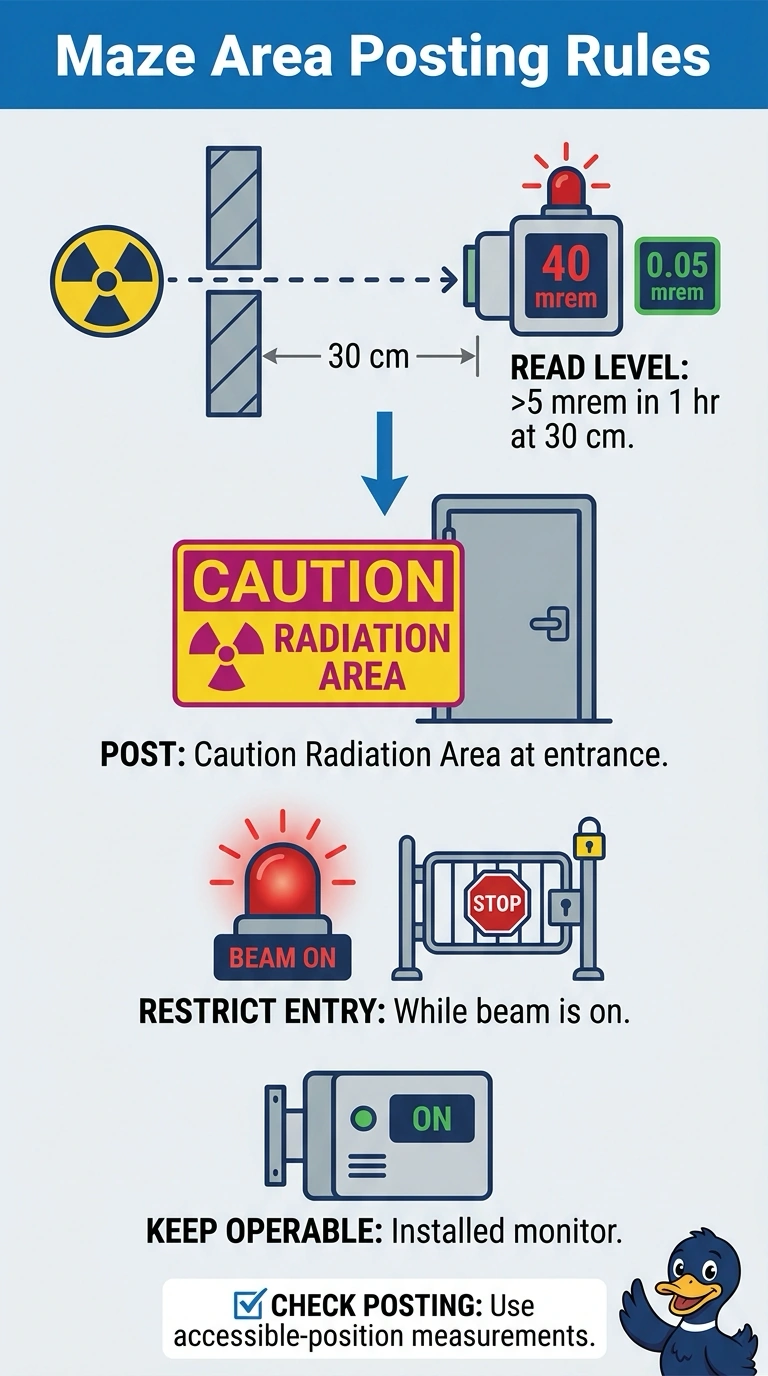
At 40 mrem per hour, your accessible spot meets the federal radiation-area criterion but not the high-radiation-area criterion, so you should post a caution radiation-area sign. Like a stoplight at the doorway, restricting entry while the beam is on and keeping the installed monitor operable are prudent site controls, though federal rules don’t require them solely because of the radiation-area classification.
Full Explanation
Under 10 CFR 20.1003, a radiation area is an area where a person could receive more than 5 mrem in one hour at 30 cm from the radiation source or from a surface penetrated by the radiation. The stated accessible-position measurement therefore meets the radiation-area criterion. A high radiation area requires more than 100 mrem in one hour at 30 cm, so that classification and sign are not appropriate here. The required federal posting is “CAUTION, RADIATION AREA” or an equivalent wording permitted by the regulation. The federal radiation-area classification does not itself require a continuous area monitor or beam-on access restriction; those are site controls appropriate to the stated interlock-bypass risk, and applicable state rules or the facility’s written program may impose additional requirements. A radioactive-material sign is for radioactive-material hazards, not radiation produced by the linac. A weekly survey is not a substitute for the installed monitor as the specified site control for a hazard that occurs during beam delivery.