
During an annual radiation protection survey of a linac running above 10 MV, you must record neutron dose equivalent at several gantry angles and in the treatment room maze, with a live reading at each point. Which detector should be used to perform this neutron survey?
Select an answer to reveal the explanation.
Short Explanation
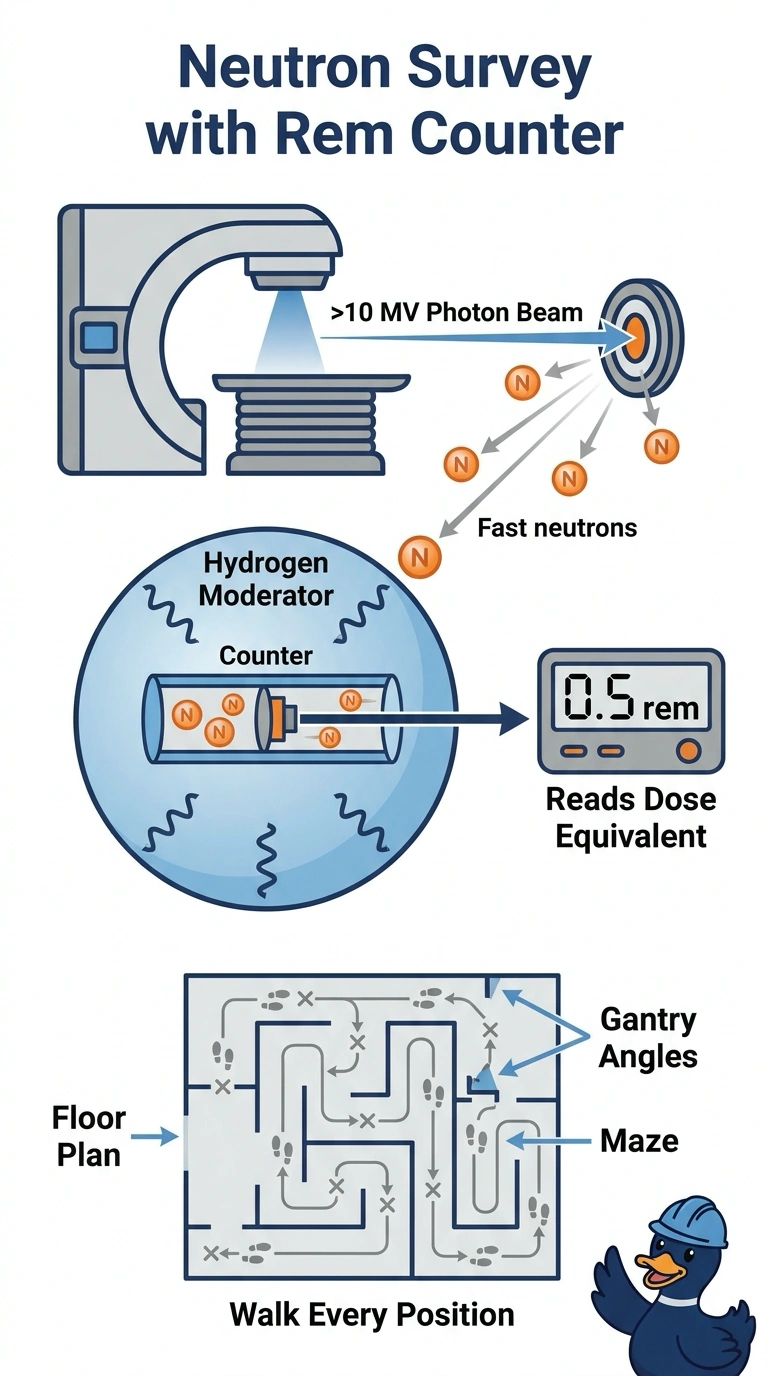
For a live neutron dose-equivalent reading at each location, use a moderated neutron rem counter: its hydrogen moderator helps it respond across the neutron energies found around a linac. You can record readings directly at the gantry angles and in the maze, rather than deriving dose equivalent from counts or waiting for an integrated dose.
Full Explanation
A moderated neutron rem counter with a hydrogenous moderator is designed to estimate neutron dose equivalent over a broad energy range, including the high-energy photoneutron fields associated with linacs operating above 10 MV. Its calibrated, displayed reading can be taken at each gantry angle and in the maze, meeting both the dose-equivalent and live-reading requirements. A Bonner sphere spectrometer can characterize neutron fields, but deriving dose equivalent from its sphere measurements generally requires spectral unfolding and calculation; it is not the direct live dose-equivalent survey reading requested. An integrating bubble neutron dosimeter can estimate accumulated dose equivalent, but it integrates exposure rather than providing a live reading at each point. A bare helium-3 counter can give a live count rate and detect thermal neutrons, but without suitable moderation and energy-response correction it does not measure dose equivalent for the broad, mixed-energy neutron field; count rate alone is not the required quantity. Exam caveat: detector response and calibration must suit the neutron spectrum, since a meter calibrated for a different spectrum may report a biased dose equivalent. In practice, confirm current calibration and energy-response suitability, then check the meter’s range and response stability before recording readings at the specified angles and maze locations.