
The daily treatment-linac routine covers safety-device tests, geometric checks, dosimetric measurements, and mechanical checks, and each part is logged separately. The physicist asks which item is a safety-device test. Which check belongs in that part of the daily routine?
Select an answer to reveal the explanation.
Short Explanation
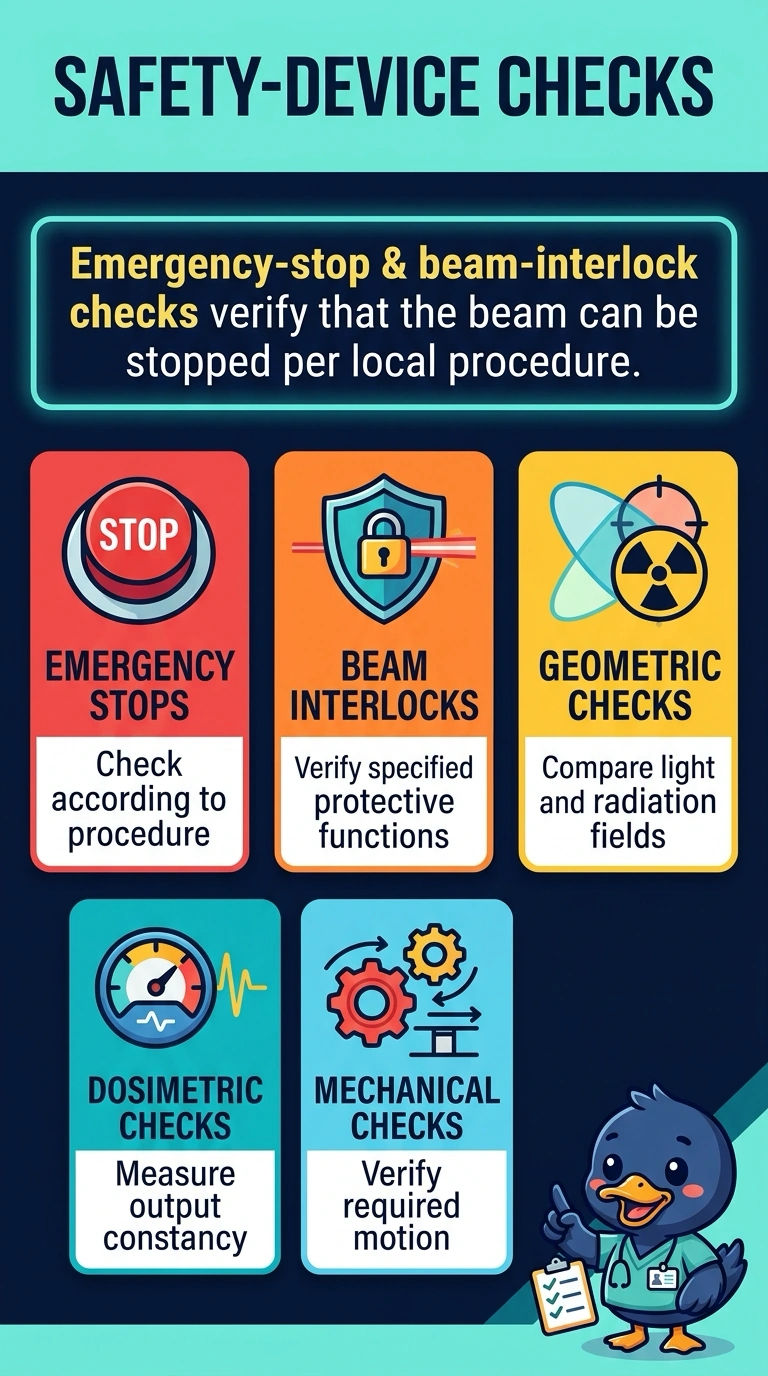
You’re checking the linac’s emergency brakes when you test emergency stops and beam interlocks, confirming the beam can be stopped as your local procedure requires. Those checks aren’t geometric, dosimetric, or mechanical measurements; they belong in the safety-device part of your daily routine.
Full Explanation
Emergency-stop and beam-interlock checks are safety-device tests because they confirm that control or access conditions trigger the specified interruption of beam delivery. Their purpose is to verify a protective function, not simply to measure treatment geometry, output, or motion. Comparing the optical distance indicator with a calibrated ruler is a valid daily geometric check of setup distance, but it does not test a device that prevents or terminates irradiation. Measuring output constancy with a reference chamber is a valid daily dosimetric check against baseline; it assesses delivered output, not a safety interlock or emergency response. Comparing gantry and collimator readouts with an independent inclinometer is a valid mechanical or geometric check of angle indication and motion, but it likewise does not verify a beam-stopping safety function. A useful exam caveat is that a check’s category is determined by what function it verifies, not merely by whether it is performed daily or contributes broadly to safe treatment. Local protocols may group or schedule tests differently, so follow the approved procedure rather than assuming a universal sequence. As a practical check, confirm that each safety-device test is performed using the specified trigger and that the expected beam-off response and any required reset or indication are documented.