
During a treatment plan review, the pelvic field is being treated with jaws open well beyond the target plus setup margin, so a band of bowel sits inside the open beam. The oncologist wants normal tissue dose reduced while target coverage stays the same. Which beam delivery change best limits unnecessary patient dose?
Select an answer to reveal the explanation.
Short Explanation
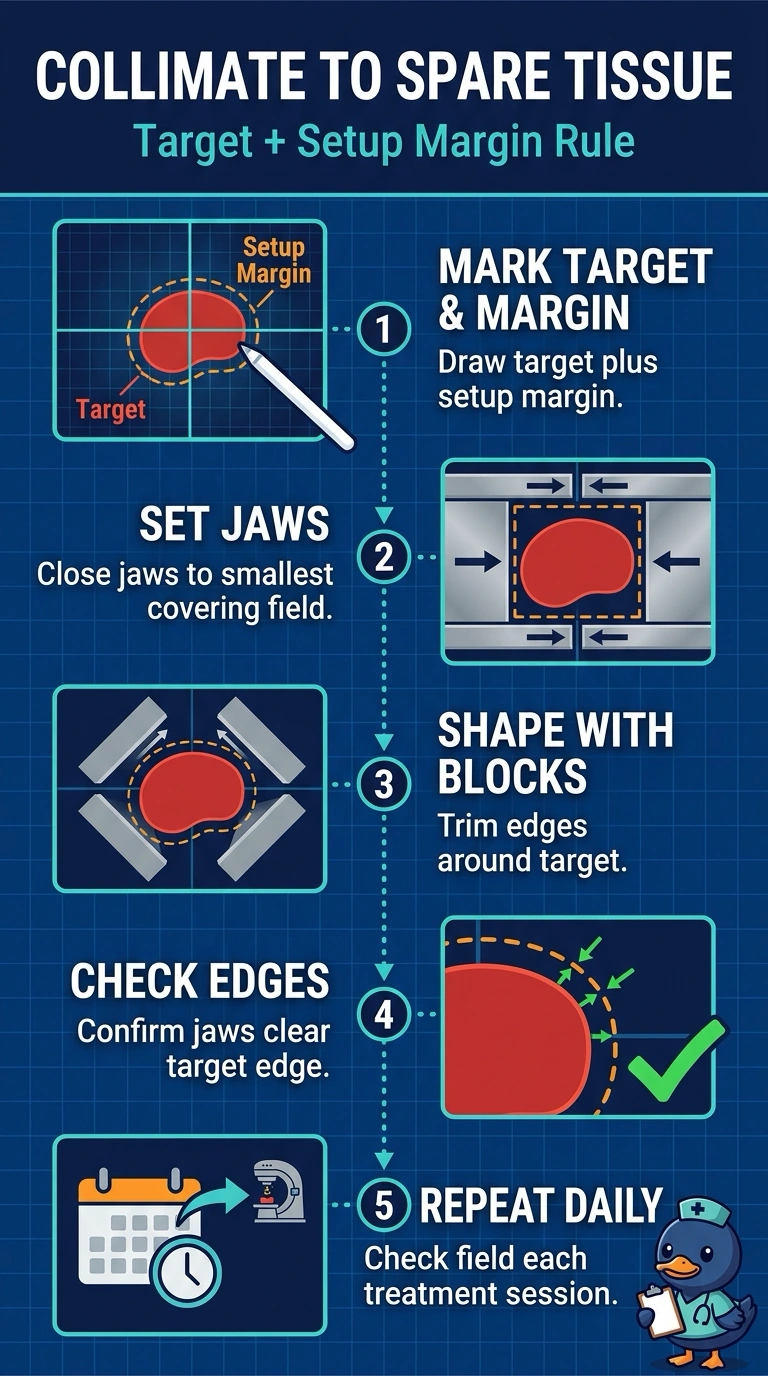
You keep the target covered while reducing unnecessary exposure by closing the jaws around the target and setup margin. Smaller collimation limits how much nearby bowel sits in the open beam.
Full Explanation
Collimating the jaws to the smallest field that still covers the target plus setup margin reduces the volume of tissue directly exposed, while the prescribed target dose and coverage remain unchanged. With less tissue irradiated, scatter produced within the patient also decreases slightly. Adding a wedge can make dose more uniform across the target, but it changes dose distribution within the field rather than narrowing the field, so the bowel remains exposed. Selecting a higher photon energy can improve depth dose and reduce entrance dose, but it does not reduce the lateral field size; bowel beside the target still lies in the open beam. Lowering monitor units while keeping the same open field reduces delivered dose to both the target and surrounding tissue, so target coverage is not preserved. An exam caveat is that energy and dose-distribution choices can optimize treatment, but field size directly governs the volume exposed. As a practical check, compare the jaw settings and block positions with the approved plan before each fraction.