
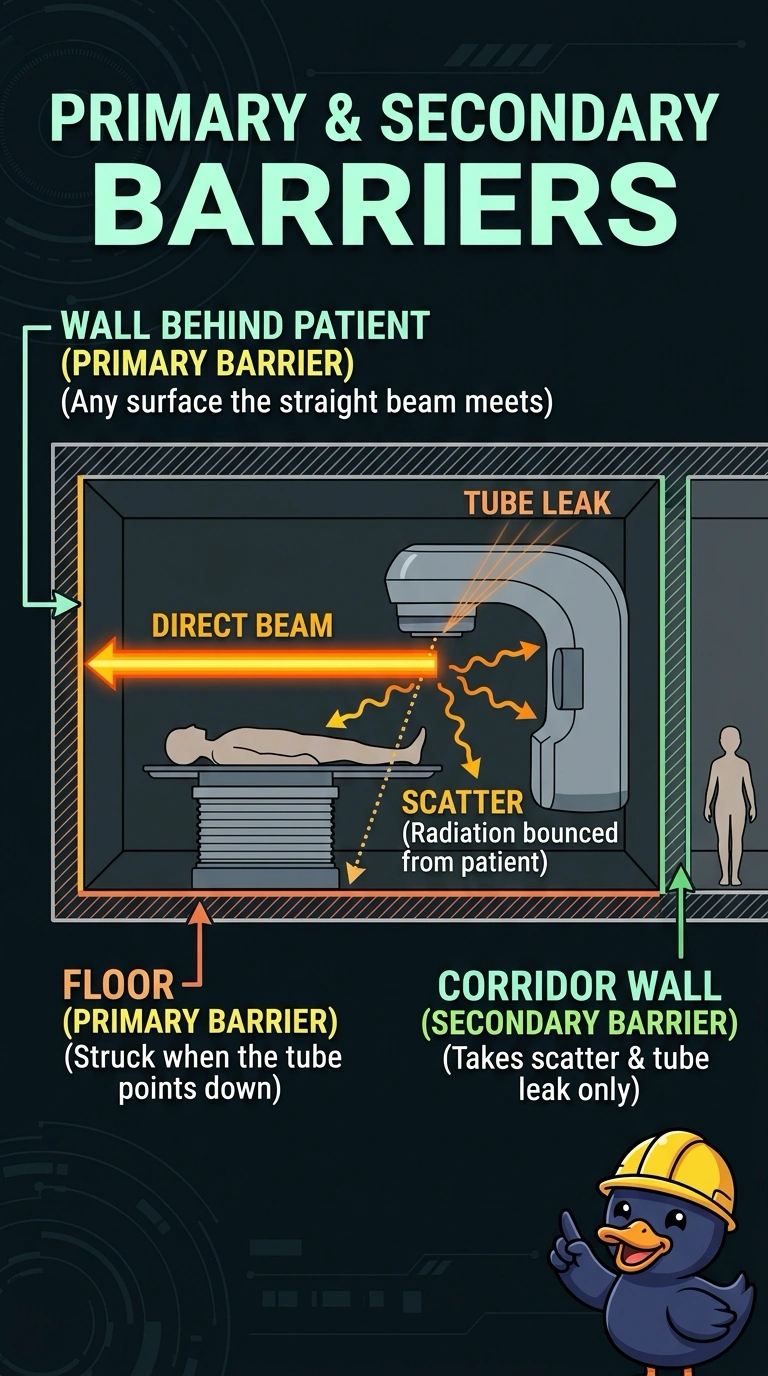
A shielding review of a new X-ray room maps three surfaces: the wall behind the patient sits in the direct beam, the corridor wall only receives scatter from the patient, and the floor is struck when the tube points downward. Which statement correctly classifies these barriers?
Select an answer to reveal the explanation.
Short Explanation
Follow the beam, not the wall's address. Anything the straight beam touches is a primary barrier, and everything else only handles scatter and leakage. Once you trace where it's heading, the corridor wall and the floor sort themselves out.
Full Explanation
Barrier classification follows where the useful beam travels, not how strong the radiation feels at a surface. A primary barrier is any structure the direct beam actually crosses, so here the wall behind the patient and the floor, struck when the tube points downward, are primary and must be designed to shield against primary radiation. A secondary barrier sits outside the beam path and contends with radiation scattered from the patient plus leakage from the tube, so the corridor wall is sized for scatter and leakage. Treating the corridor wall as primary fails on definition, because scatter, however strong, never converts a secondary barrier. Calling all three surfaces primary fails on the same definition by skipping the beam-path test. Calling the floor secondary fails on the stated geometry, which puts the downward beam on it. Exam caveat: items often describe a surface by its location rather than its exposure, so ask what beam reaches it. Practical check: trace the direct beam in every direction the tube can move, then label each surface it touches.