
A patient who completed a full course of pelvic irradiation years ago now needs a second postoperative course that partly overlaps the old high-dose region. The new plan uses a similar dose per fraction and treats a similar tissue volume. Which factor most threatens normal tissue tolerance in the overlapping area?
Select an answer to reveal the explanation.
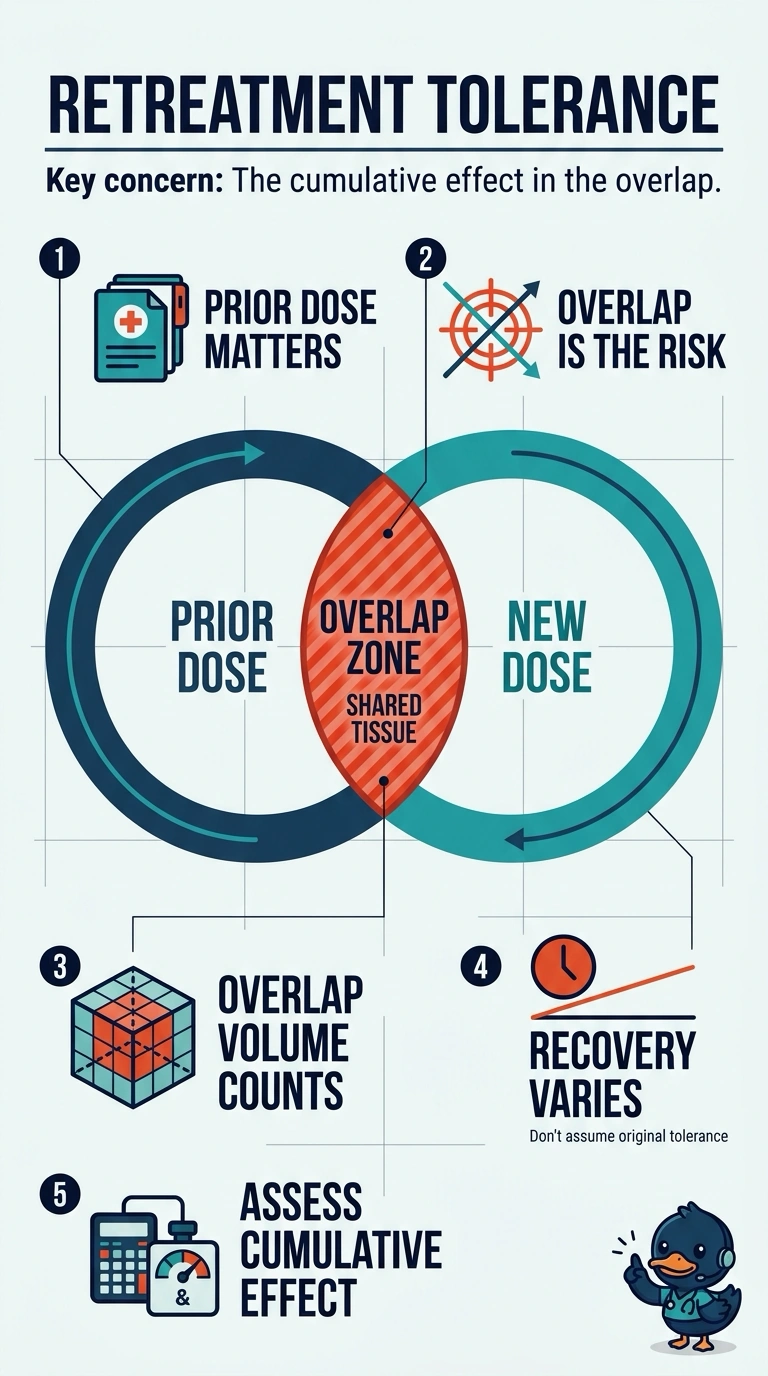
Short Explanation
Think of the overlapping tissue as a shared section of road that has already taken wear from the first course. You need to account for the prior dose and any recovery when judging the cumulative effect; similar fraction size and tissue volume don’t erase that earlier exposure.
Full Explanation
When a second course partly overlaps a previously irradiated region, the key concern is the cumulative effect in that overlap, accounting for the prior dose and any recovery. The years since the first course matter, but they do not guarantee that the tissue has healed back to its original tolerance; recovery after radiation is variable and should not be assumed complete. The daily dose alone describes only part of the new course: a similar dose per fraction does not show how much dose the overlapping tissue has already received. Likewise, treating a similar tissue volume does not make the repeat exposure safe, because that volume includes tissue exposed during the first course. Cumulative effect should be assessed using the available dose records and appropriate radiobiologic methods, rather than by simply adding physical doses or assuming that prior tolerance is a fixed amount that has been spent. Exam caveat: elapsed time may allow some recovery, but it cannot by itself establish restored tolerance. Practical check: retrieve the original dose records, map the overlap on the planning CT, and document the cumulative dose assessment before approval.