
A patient receiving pelvic treatments has a knee that stays bent and a pelvis that keeps sliding toward the foot of the table during each fraction. Which combination of positioning aids should the therapist set up to support the knee and limit pelvic movement?
Select an answer to reveal the explanation.
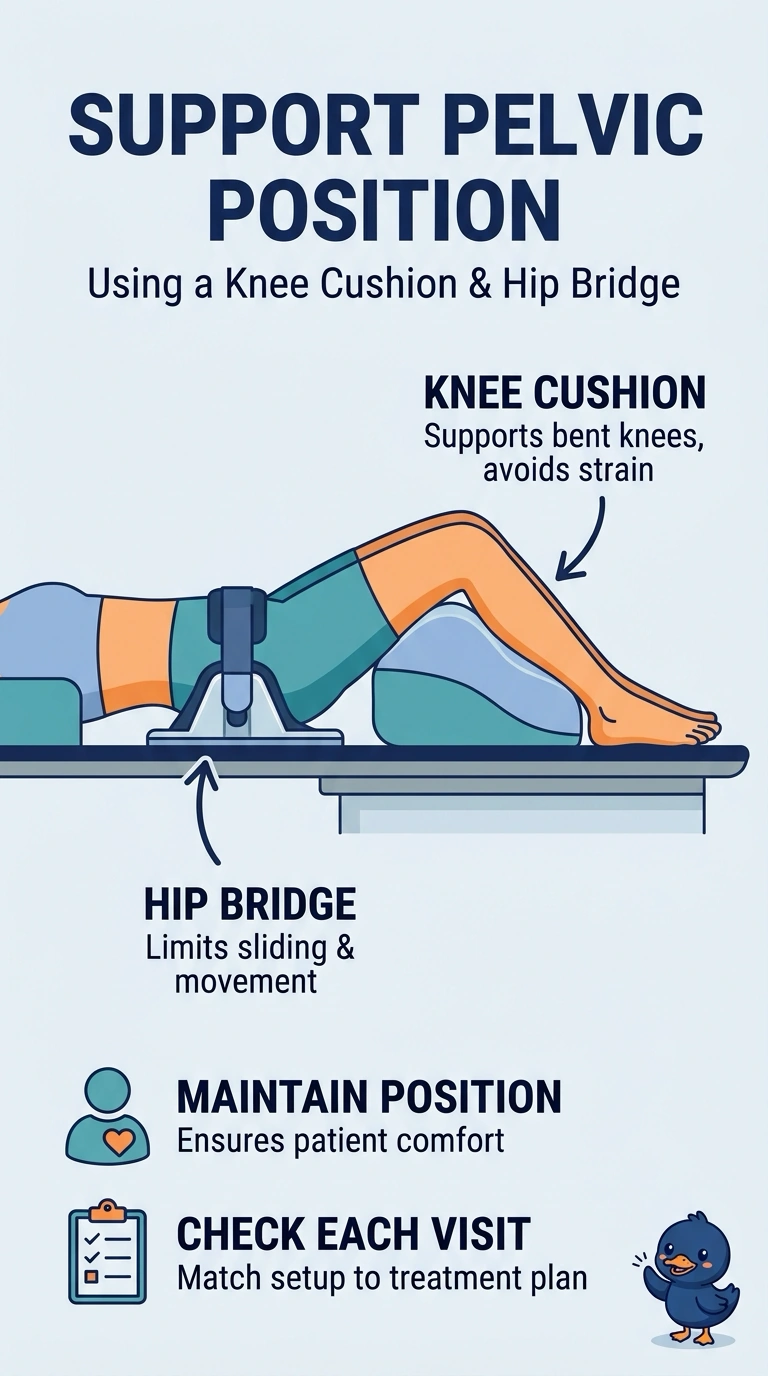
Short Explanation
You can support the bent knee with a knee cushion and use a hip bridge to help keep the pelvis from sliding toward the foot of the table. Together, these positioning aids address both concerns and help steady your setup.
Full Explanation
A knee cushion accommodates and supports the knee that remains flexed, while a hip bridge provides a stable contact point to help prevent the pelvis from migrating toward the foot of the table. Using both directly addresses the two positioning problems. A hip bridge with a pelvic strap can help limit sliding, but it does not provide dedicated support for the bent knee; a strap does not replace a knee cushion. Cushioning the knee and securing the feet in indexed supports supports the knee, but foot supports primarily control foot and leg position and do not reliably limit pelvic translation. A knee cushion with an indexed upper-body immobilizer supports the knee and helps align the upper body, but the immobilizer does not directly secure the pelvis against the described movement. Exam caveat: distinguish aids that support a joint from aids that control the specific region that is moving; an aid that improves general alignment may not prevent pelvic sliding. Practical check: before treatment, confirm that the knee remains comfortably supported and the pelvis stays in its marked position during a brief rehearsal, without painful pressure or unwanted movement.