
A therapist covering three rooms reads a conditioning treatment before a stem cell transplant, an electron treatment across the entire skin surface, and a photon course to a lung primary. Which pairing of technique with clinical purpose is accurate?
Select an answer to reveal the explanation.
Short Explanation
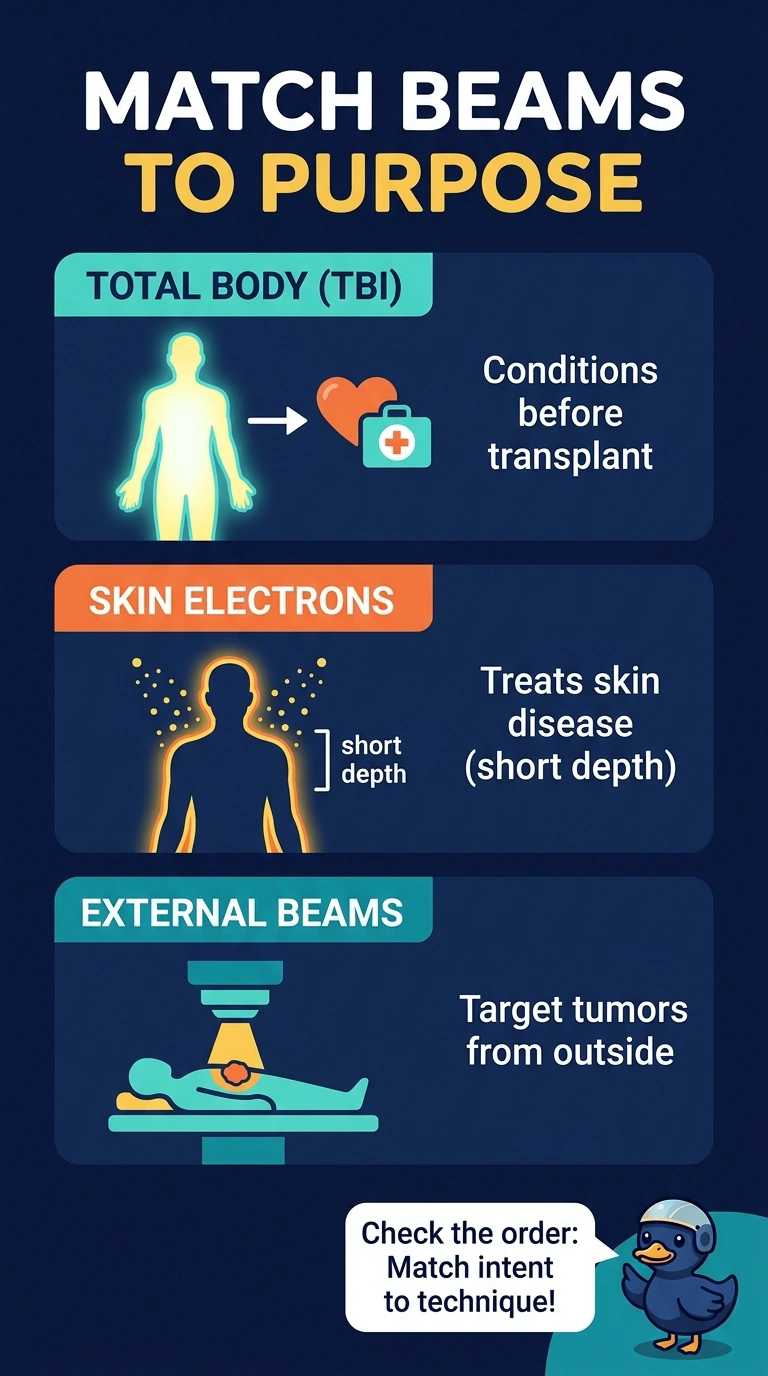
You matched each technique to the job it actually does. Total body irradiation can condition the whole body before transplant, while total-skin electrons treat widespread skin disease and external beams target a lung tumor from outside. You can think of it as choosing the right tool for the treatment area.
Full Explanation
The accurate pairing links each technique to its clinical role: total body irradiation (TBI) may be used in transplant conditioning to treat disease throughout the body and prepare for stem-cell infusion; total-skin electron therapy delivers electrons across the skin surface for widespread cutaneous disease; and external-beam radiotherapy directs radiation from a machine outside the patient toward a lung tumor. Intracavitary brachytherapy places sources in a cavity, so it does not describe external-beam treatment of a lung primary. Localized electron therapy can treat a superficial skin lesion, but its limited field does not cover the entire skin surface; the TBI and external-beam pairings remain appropriate. High-dose chemotherapy can be used for transplant conditioning, but it does not identify the specified radiation technique, TBI; the skin and lung pairings remain appropriate. Exam caveat: transplant conditioning regimens vary, and chemotherapy may be used alone or with radiation, so a clinically valid approach is not necessarily the technique named in the question. In practice, verify the prescription, treatment volume, modality, and intent—conditioning, total-skin treatment, or focal tumor irradiation—before confirming the setup.