
A pancreatic tumor shows about 2 cm of craniocaudal motion on fluoroscopy, and the patient cannot sustain a breath hold because of chronic lung disease. The plan must keep motion small and tie beam delivery to a reproducible respiratory phase. Which motion-management approach meets the motion and phase requirements?
Select an answer to reveal the explanation.
Short Explanation
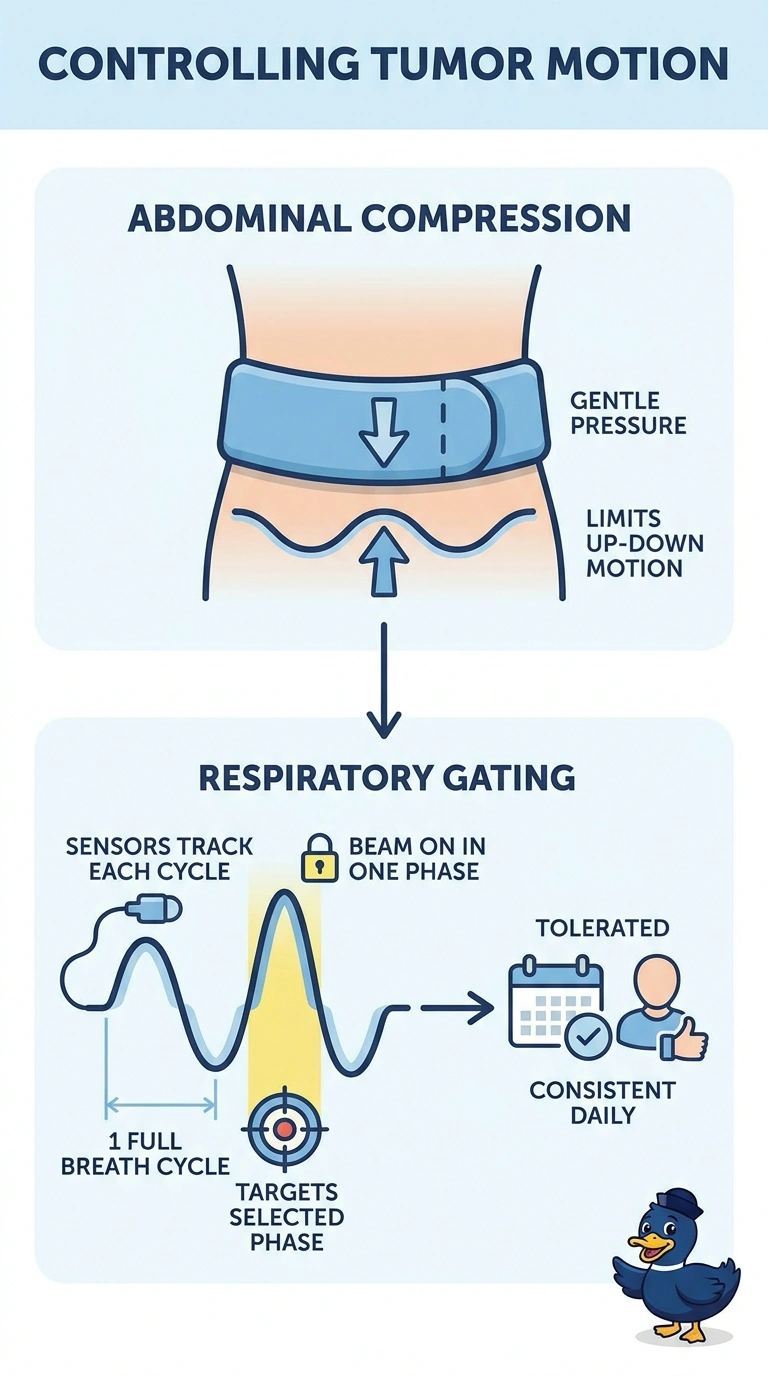
You need both parts of the motion-management plan: abdominal compression can reduce the tumor’s motion, while gating ties beam delivery to a reproducible respiratory phase. Combining them addresses both requirements; compression or gating alone does not.
Full Explanation
The approach that combines tolerated abdominal compression with phase-based gating provides two complementary controls: compression is intended to reduce the tumor’s respiratory excursion, while gating restricts beam delivery to a reproducible part of the breathing cycle. Together, these measures address both the need to keep motion small and the requirement to synchronize treatment with a consistent respiratory phase. Compression followed by continuous delivery may reduce excursion, but it does not tie beam delivery to a reproducible phase; residual motion can still occur during irradiation. Free-breathing phase gating can synchronize delivery, but without compression or another motion-reduction measure, the tumor may retain substantial excursion between or within gated windows, so the motion-small requirement is not met. Real-time tumor tracking during free breathing can maintain alignment by following the target, but continuous tracking does not restrict delivery to a reproducible respiratory phase. An exam caveat is that gating and tracking are distinct strategies: gating selects when the beam is on, whereas tracking adjusts the beam to a moving target. In practice, verify that compression is tolerated and measurably reduces internal target motion, and confirm that the respiratory surrogate reliably corresponds to tumor position before treatment.