
In a department safety huddle, a trainee reviews the day's records: patient skin absorbed dose of 2 Gy, an eye-lens dose-equivalent reading of 0.3 mSv, a survey reading of 0.5 µC/kg, and tube output air kerma of 12 µGy per exposure. Which recorded value already includes a weighting for radiation type?
Select an answer to reveal the explanation.
Short Explanation
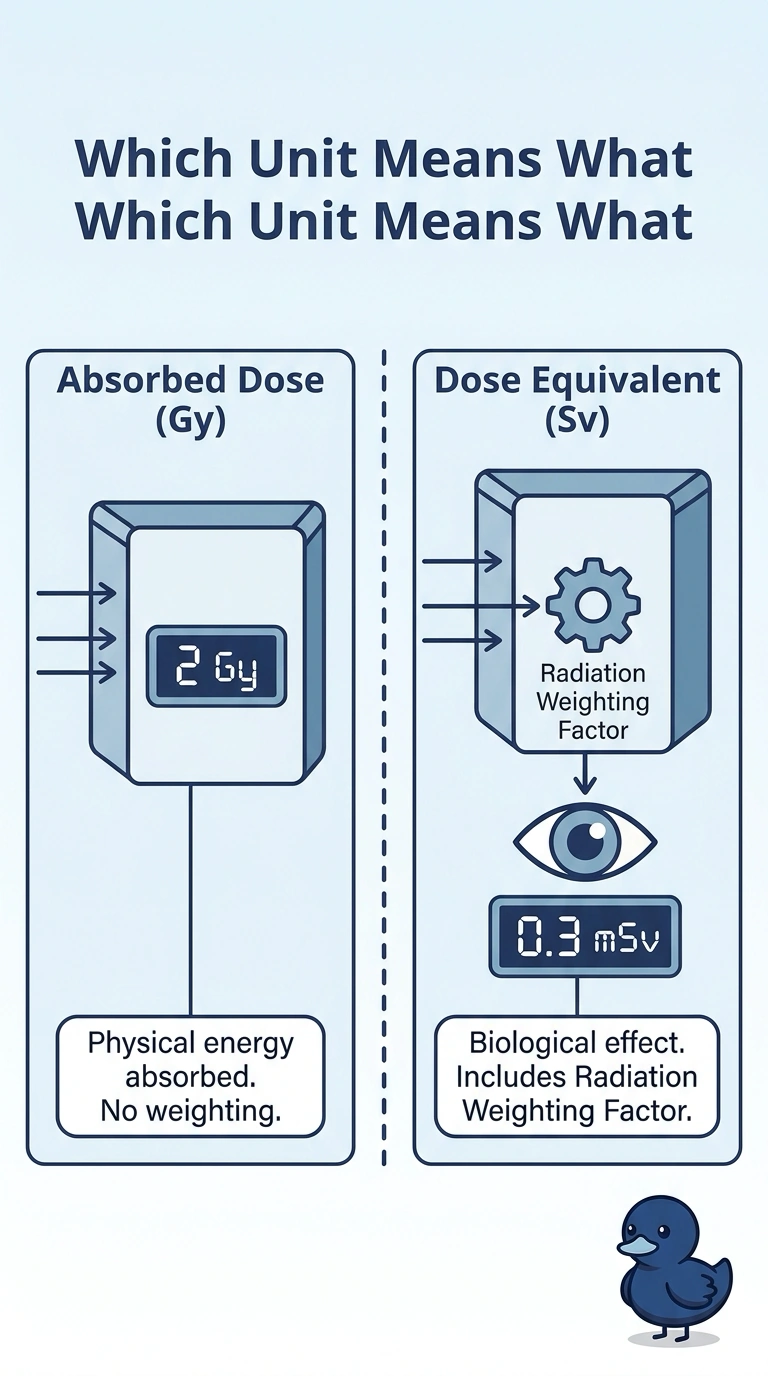
You can spot the eye-lens value as dose equivalent in sieverts, which already accounts for radiation type—like a score adjusted for difficulty. Gray reports absorbed dose, while C/kg and air kerma describe radiation in air, not a sievert-weighted dose.
Full Explanation
Equivalent dose is calculated from absorbed dose in gray using a radiation weighting factor, so the eye-lens dose-equivalent value in millisieverts is the listed record that includes weighting for radiation type. This does not mean that the value includes a tissue weighting factor; that factor is used when calculating effective dose. Absorbed dose in gray reports energy deposited per unit mass. Exposure in coulombs per kilogram describes ionization in air, while air kerma in gray measures energy transferred to charged particles per unit mass of air. Neither quantity, by itself, includes radiation or tissue weighting. A useful check is to identify the quantity and unit before comparing dose records.