
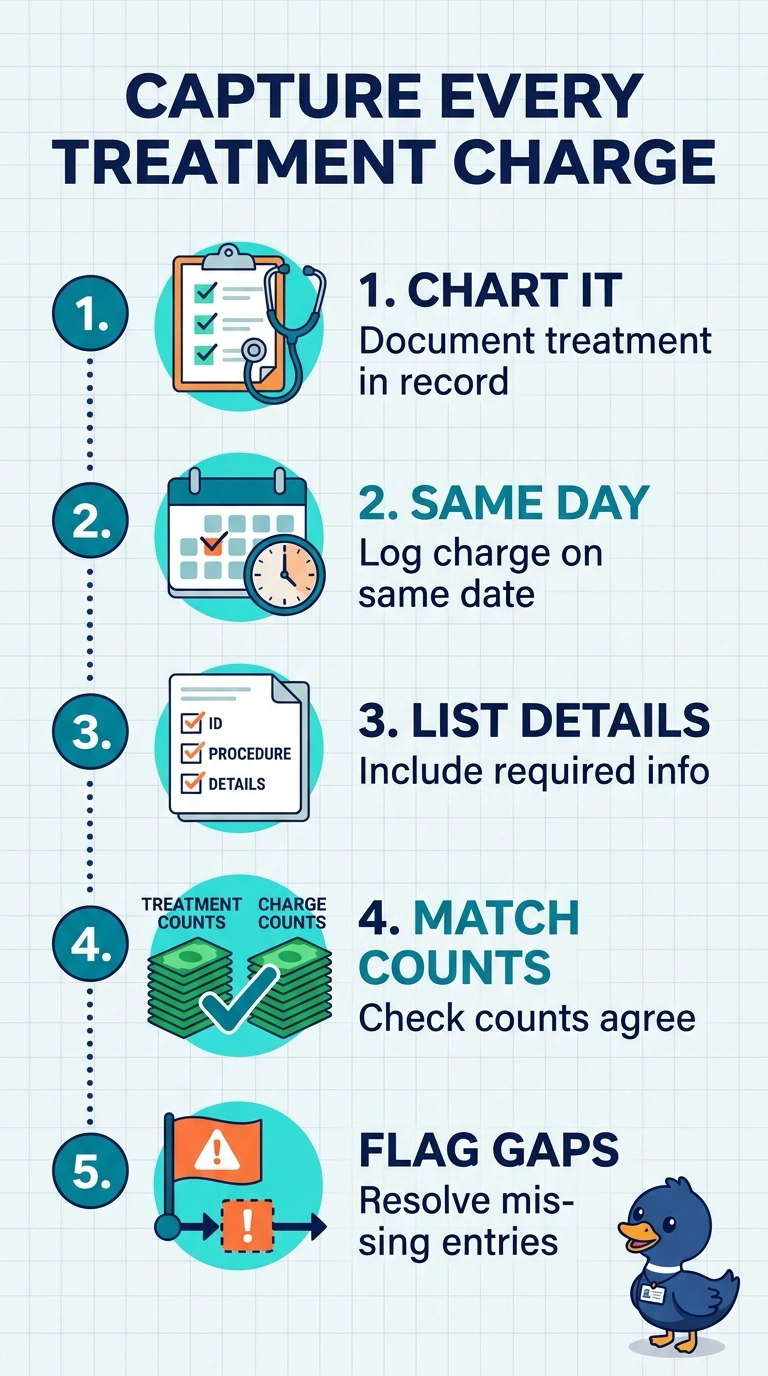
At the end of an evening shift, the therapist realizes one patient's treatment was delivered but was missing from the day's charge log, so the billing count is short by one session. Under the routine charge-capture process, which documentation step should happen first to capture that charge for the date?
Select an answer to reveal the explanation.
Short Explanation
Document the treatment you delivered in the chart and same-day charge log, including all required identifying details. Like checking off a task while it’s still fresh, this contemporaneous step helps you capture the charge for the correct date and resolve the mismatch promptly.
Full Explanation
The required step is to document the treatment that was actually delivered in both the clinical chart and the same-day charge log, including the details needed to identify and support the charge. Doing this promptly creates a contemporaneous record and lets the routine charge-capture process account for the session on the correct date. Recording the service in both places with its standard code and date is not sufficient if patient and encounter identifiers are omitted; without them, the entry may not be reliably matched to the right person and visit. Entering identifying details in the same-day log is also insufficient when the treatment itself is missing from the chart, because the existing chart note cannot substitute for documenting this service there. Completing both records with the required details during the next shift includes the necessary information, but the delay fails the stated same-day capture requirement and can leave that date’s charge count incomplete. An exam caveat is that local workflows may specify particular fields or approved correction procedures, so a code and date alone may not satisfy documentation requirements. In practice, verify the patient and encounter, treatment date and service, and required provider or modality fields against your organization’s charge-capture policy, then confirm that the charge appears in the same-day log.