
Before the first fraction, a colleague asks you to verify the monitor units for a new 6 MV plan. The chart lists the prescribed dose at the target, the target depth, the field size and the distance from the source for the setup. Which recalculation confirms that the monitor units match the prescription?
Select an answer to reveal the explanation.
Short Explanation
You rebuilt the calculation rather than trusting the number on the screen. A monitor unit is a slice of dose whose value depends on depth, field size and distance. Like coins in another currency, the same count has a different value until you check the rate.
Full Explanation
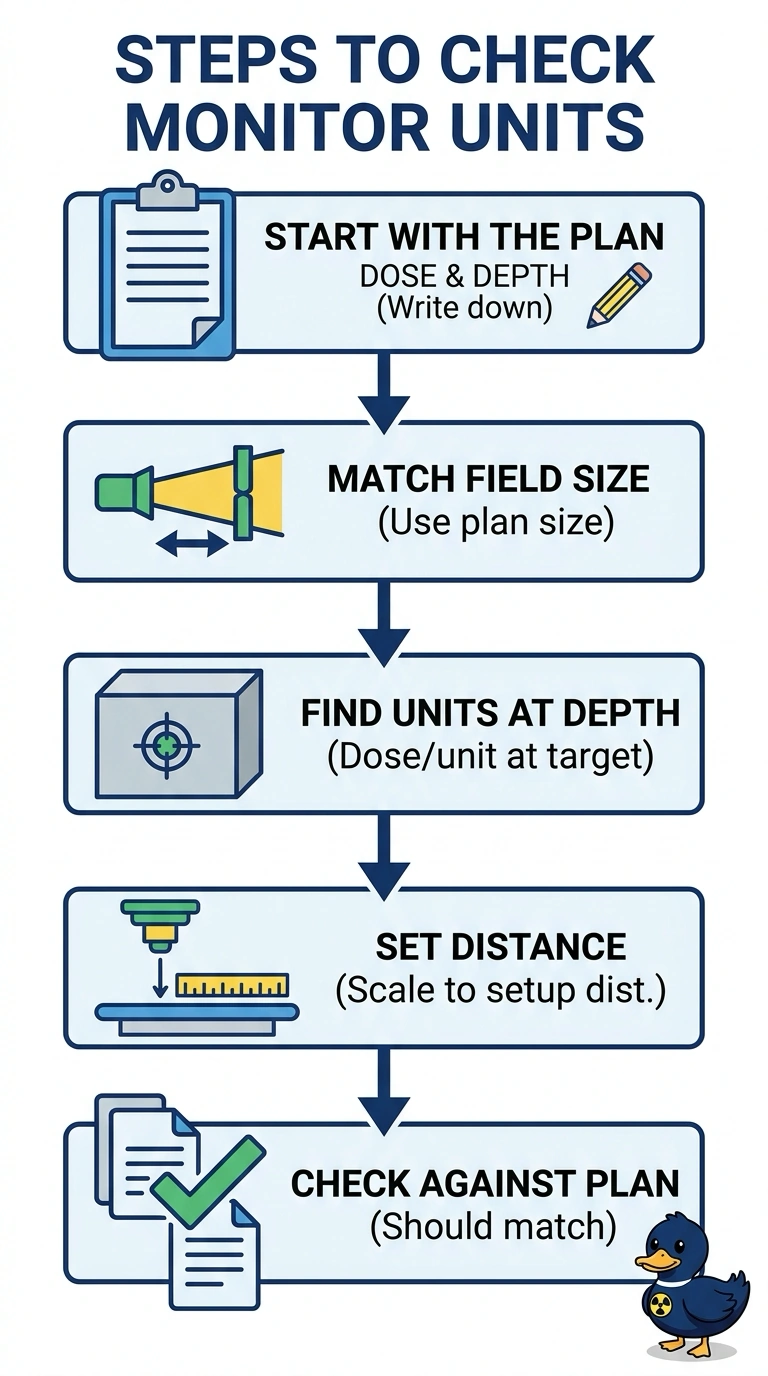
To verify the monitor units, independently rebuild the calculation from the prescription: determine dose per unit at the target depth for the recorded field size, then scale it to the setup distance. Dose per unit changes with depth as attenuation and scatter change, and with field size and distance, so these charted conditions determine what each unit delivers. Dividing the prescribed dose by the machine’s calibration output at the reference depth omits the target-depth and setup-distance adjustments; it assumes those differences do not matter and therefore does not verify the plan. Applying only the wedge transmission factor accounts for that one output modifier but leaves depth, field size and distance unaddressed, making it an incomplete check. Comparing the monitor units with the record-and-verify printout can confirm that the value was transferred consistently, but it does not independently establish that the physics calculation matches the prescription. An exam caveat is that a comparison with a prior or recorded value may feel like verification, yet it is not the same as recalculating. Before treatment, use the chart’s target depth, field size and setup distance to calculate the monitor units, then compare the result with the plan value.