
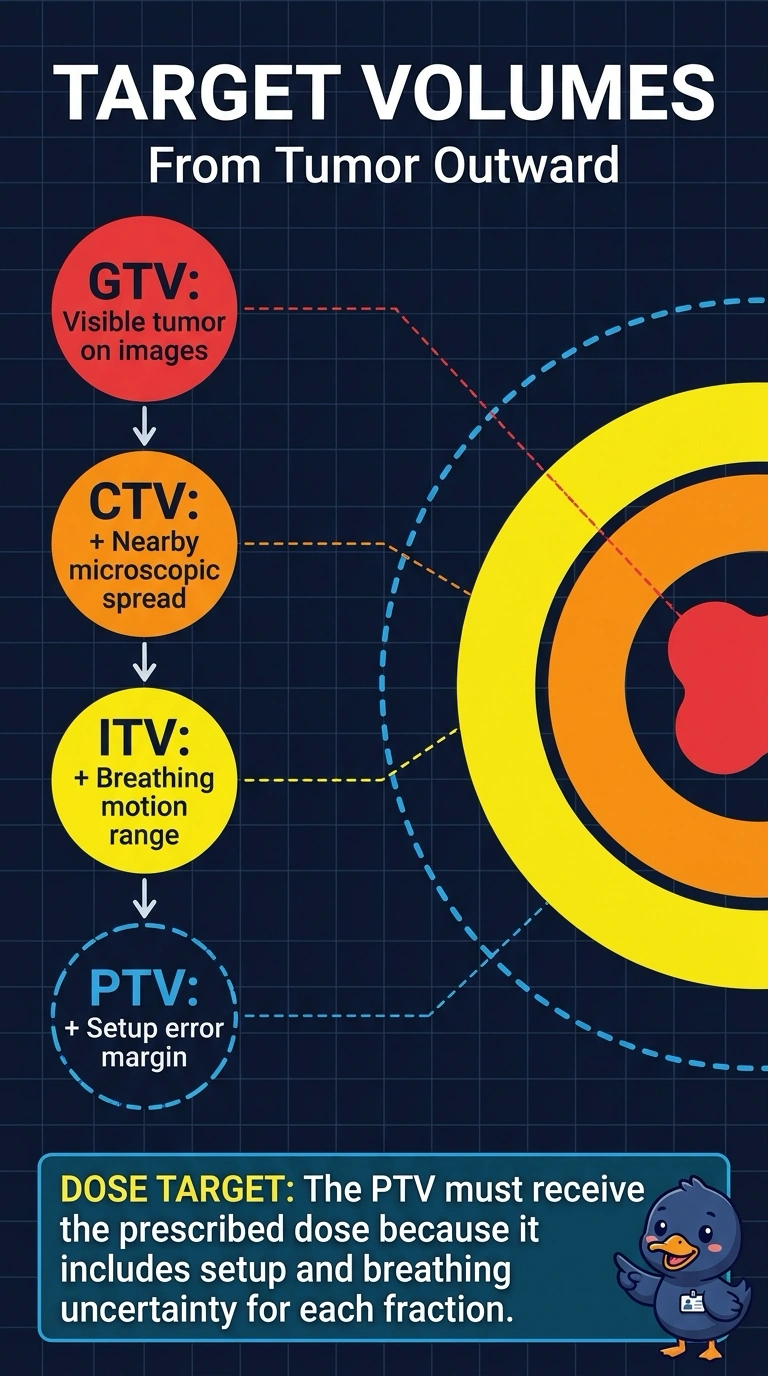
While reviewing a simulation for a lung primary you see a GTV on the visible tumor, a CTV adding microscopic spread, an ITV growing and shrinking with breathing, and a PTV adding setup margin. Which prescription volume must receive the prescribed dose at every fraction?
Select an answer to reveal the explanation.
Short Explanation
You're reading the volumes right when you follow what each margin adds. The PTV is the outermost shell, so setup wobble still doesn't cost you dose coverage. It's the extra floor space you leave around a painting so a wobbly frame won't clip it.
Full Explanation
The GTV outlines visible or palpable gross tumor on imaging, the CTV adds a margin for subclinical microscopic spread around it, the ITV adds the range of motion from breathing or organ movement, and the PTV adds setup and planning uncertainty so the prescribed dose actually covers the intended target through every fraction. The PTV is therefore the volume that must receive the prescription, because it is the outer envelope that still guarantees CTV coverage when the patient sits a little differently each day. Treating the gross tumor as the target ignores microscopic disease lying outside the visible edges, which is exactly what the CTV exists to capture. Attaching setup and motion margins to the CTV mixes margin types, since those uncertainties belong to the planning volumes rather than to the disease description. Reading the ITV as the prescription volume confuses respiratory motion with setup error and leaves positioning variation unaccounted. An exam caveat: margin wording and naming conventions vary between institutions, but the hierarchy from gross disease outward to setup uncertainty stays the same. A practical check is to match each volume name on the plan summary to the intent stated in the order.