
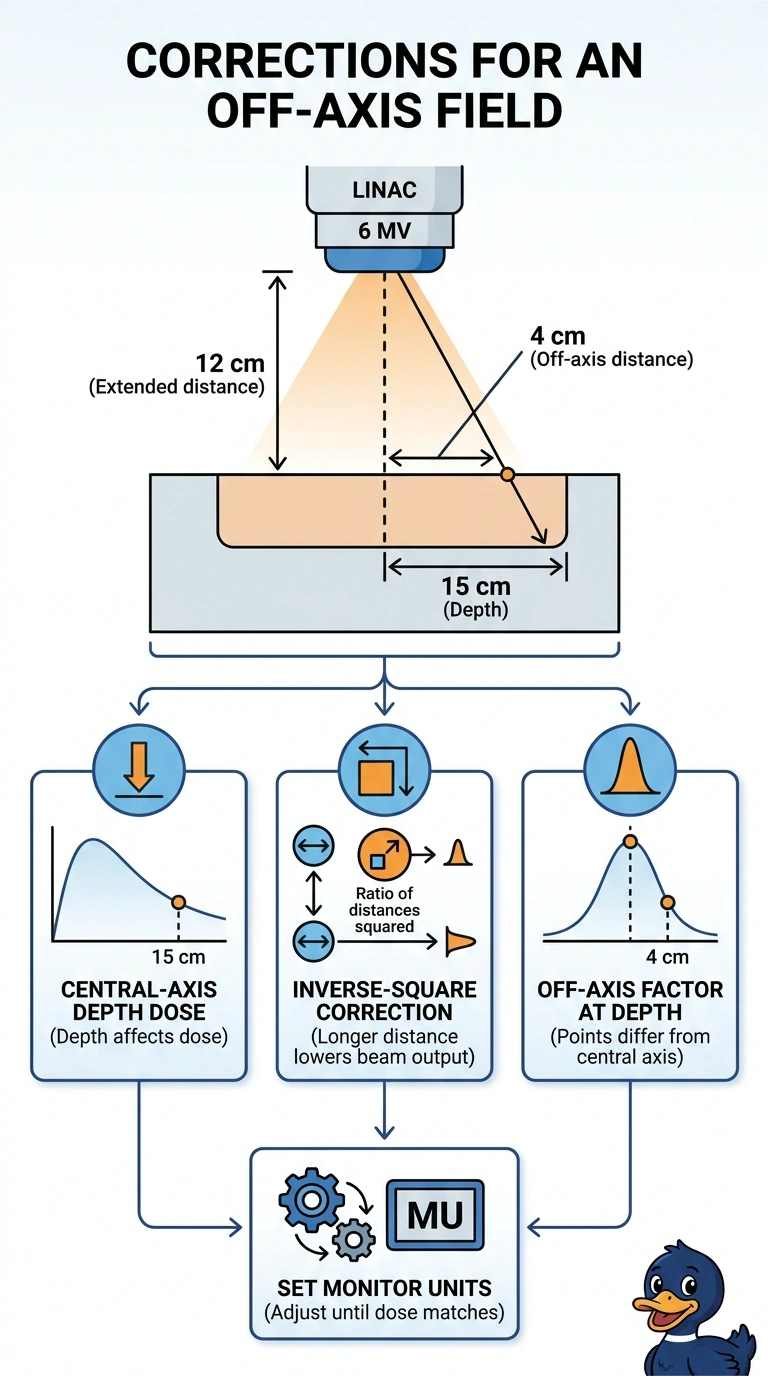
On a 6 MV unit, the skin surface sits 15 cm farther from the source than the nominal setup distance, the target lies 4 cm off the central axis at a depth of 12 cm, and the dose is prescribed to that point. Which set of corrections must be applied to this field's monitor units?
Select an answer to reveal the explanation.
Short Explanation
You need an inverse-square correction for the extra source-to-skin distance, an off-axis factor for the target’s position at depth, and the central-axis depth dose for its depth. It’s like adjusting for three separate things that change the dose: distance, beam position, and depth.
Full Explanation
Machine output is calibrated for a nominal setup, so moving the skin surface farther from the source changes the fluence reaching the patient. An inverse-square correction is needed for the extended distance. A point off the central axis may have a different dose per monitor unit than the central-axis point, so an off-axis factor at the target depth is also needed. The target's depth determines the applicable central-axis depth-dose value. Holding nominal output while correcting only lateral position omits the extended-distance correction. Correcting distance and depth but using the central-axis value alone omits the off-axis correction. Applying distance and off-axis corrections but using the calibration-depth dose omits the target-depth correction. In practice, planning systems may account for distance effects within their calculation, but the underlying physics still applies. Confirm that the calculation accounts for distance, lateral position, and depth.