
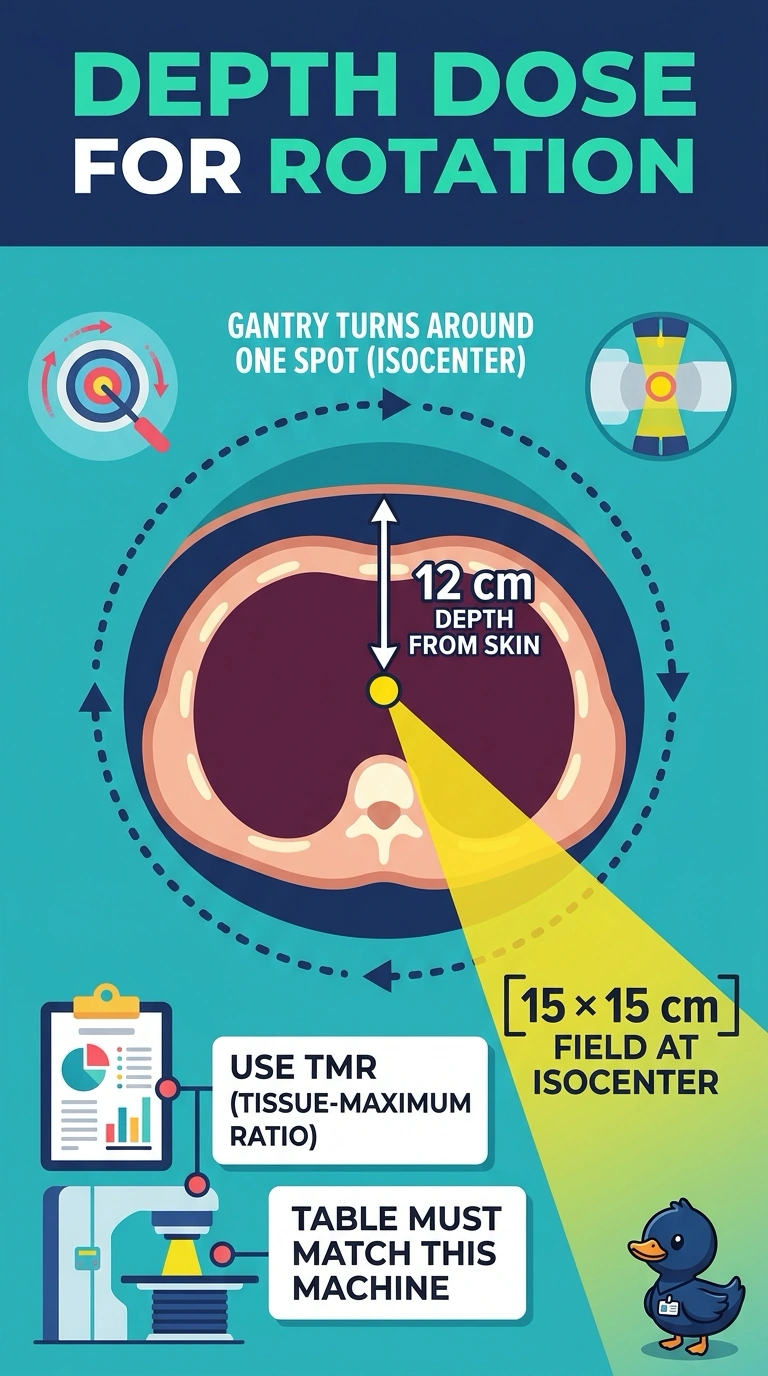
For an isocentric treatment delivered at a 100 cm source-to-axis distance, the target lies 12 cm below the skin on the central axis, and the beam shaping gives a 15 × 15 cm field at the isocenter of a 6 MV beam. Which quantity should supply the depth dose factor used in this calculation?
Select an answer to reveal the explanation.
Short Explanation
With the gantry rotating around a fixed point, you should pull the depth dose from tissue-maximum ratio data at that same field size. Percentage depth dose is tied to one setup distance, and an output factor doesn't cover attenuation with depth. Field size still counts, so you can't fall back on the 10 × 10 calibration entry.
Full Explanation
In an isocentric setup the source-to-axis distance stays fixed while the beam rotates around a single point, so depth dose is expressed as the ratio of dose at depth to dose at maximum depth for the same source position; that is the tissue-maximum ratio, and it must be taken for the treatment field size, here 15 × 15 cm at the isocenter. The percentage depth dose approach fails because those values are measured at a fixed source-to-surface distance, so carrying them onto a rotating isocentric field leaves an uncorrected distance error. The calibration field table approach uses the correct quantity but the wrong field size, and scatter from the larger opening lifts output above the 10 × 10 entry. The output-factor approach corrects field size only and never accounts for attenuation between the surface and the target. Exam caveat: a stem that says the gantry rotates around a fixed point points to SAD quantities, while a fixed distance points to SSD quantities. A practical check: confirm depth from the skin surface, field size at the isocenter, and that the table matches this machine.