
A medical physicist is documenting monthly output constancy for a 6 MV beam by measuring dose at reference depth in water against the machine's saved baseline. The result must be accurate to about one percent and available immediately so any drift can be corrected before the next treatment day. Which detector is the best choice for this output measurement?
Select an answer to reveal the explanation.
Short Explanation
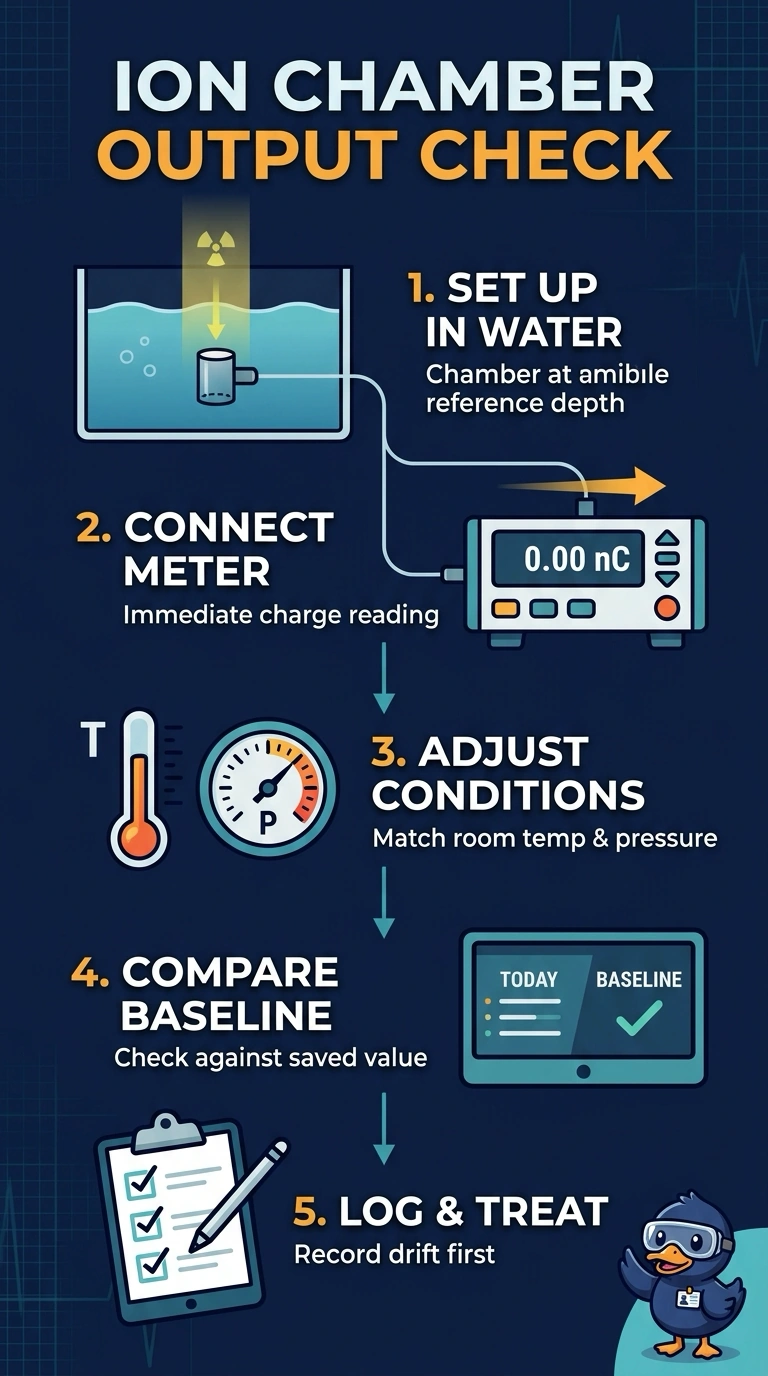
For your monthly 6 MV output check, a calibrated thimble ion chamber in water gives you an accurate reading at reference depth right away, so you can compare it with the saved baseline and correct any drift. It’s like using a precise scale instead of a smoke alarm—you need a direct dose measurement, not just a signal.
Full Explanation
A calibrated thimble ion chamber placed in water at the reference depth is the best choice because it measures absorbed dose under reference conditions and provides an immediate, stable reading suitable for comparison with the saved baseline. With appropriate calibration and setup, it can support output constancy checks at about the one-percent level, allowing a detected drift to be addressed before treatment resumes. A calibrated EPID provides a useful, immediate signal for routine output monitoring, but its signal is acquired at the imager rather than as dose at the reference depth in water; it is therefore not the requested reference-condition measurement. An uncorrected silicon diode can be placed in water at the reference depth and responds promptly, but its response can vary with temperature and dose rate, so without suitable corrections it may not reliably achieve the stated accuracy. A calibrated ion chamber in a water-equivalent solid phantom can give accurate, prompt measurements at an equivalent depth, but the specified measurement medium is water, not solid phantom material. Exam caveat: detector suitability depends on calibration, measurement geometry, and the constancy protocol; a detector used for relative checks is not automatically suitable for an absolute reference measurement. Practical check: verify chamber calibration status, water depth and setup, temperature-pressure correction where applicable, and agreement with the institution’s baseline procedure.