
A patient receiving pelvic radiotherapy lines up on the tattoos and wall lasers, yet daily cone beam CTs show a different 5 to 8 mm error with each therapist. The knee sling, foot plate, and table index are set by eye each morning rather than locked to recorded positions. Which correction will most reliably restore this patient's setup reproducibility?
Select an answer to reveal the explanation.
Short Explanation
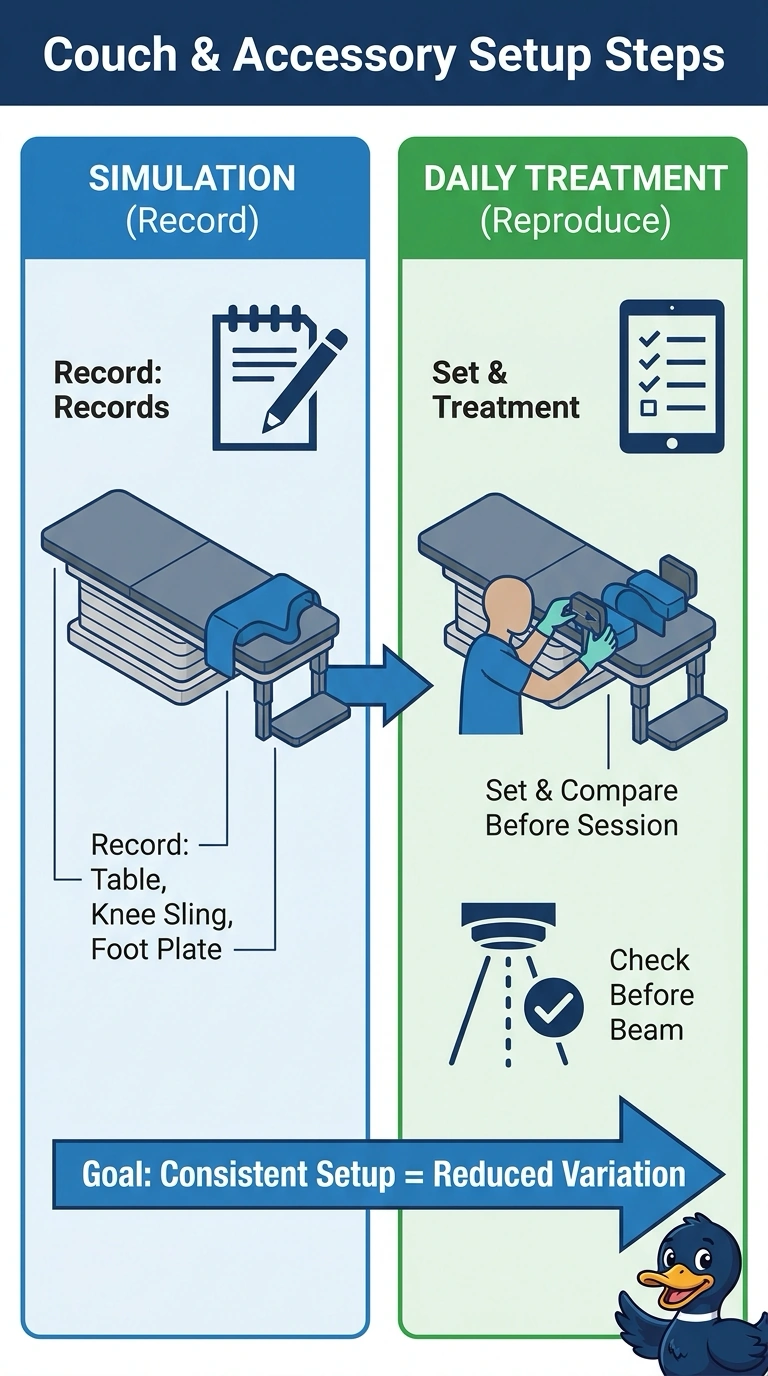
Those shifting errors likely come from accessories being positioned by eye, not from your patient’s alignment. Record the couch index and accessory positions at simulation, then match them before every treatment—like setting a chair to the same marked notches instead of guessing. You’ll give every therapist the same baseline setup.
Full Explanation
Reproducibility here is being lost in the setup accessories, and recording and reproducing their positions addresses that variation. The simulation couch index and accessory positions, including the knee sling and foot plate, can be recorded so different therapists can reproduce the setup consistently. A permanent isocenter shift does not address a variable setup and could build the average error into the treatment position. Correcting the daily CBCT error can address that fraction's alignment but does not prevent the underlying setup variation. Using one therapist may reduce variation, but it is less reliable than a reproducible setup that all therapists can follow. A permanent shift may be appropriate when a genuine systematic offset is confirmed, so establish the pattern before choosing it. A practical check is to compare the recorded index and accessory positions for several fractions with the approved simulation entry.