
A chest wall target sits over the lung, the open 6 MV field extends 2 cm past the target on every side, and the plan shows slight dose build-up near the skin. Which beam change best limits dose to uninvolved tissue while keeping the target dose unchanged?
Select an answer to reveal the explanation.
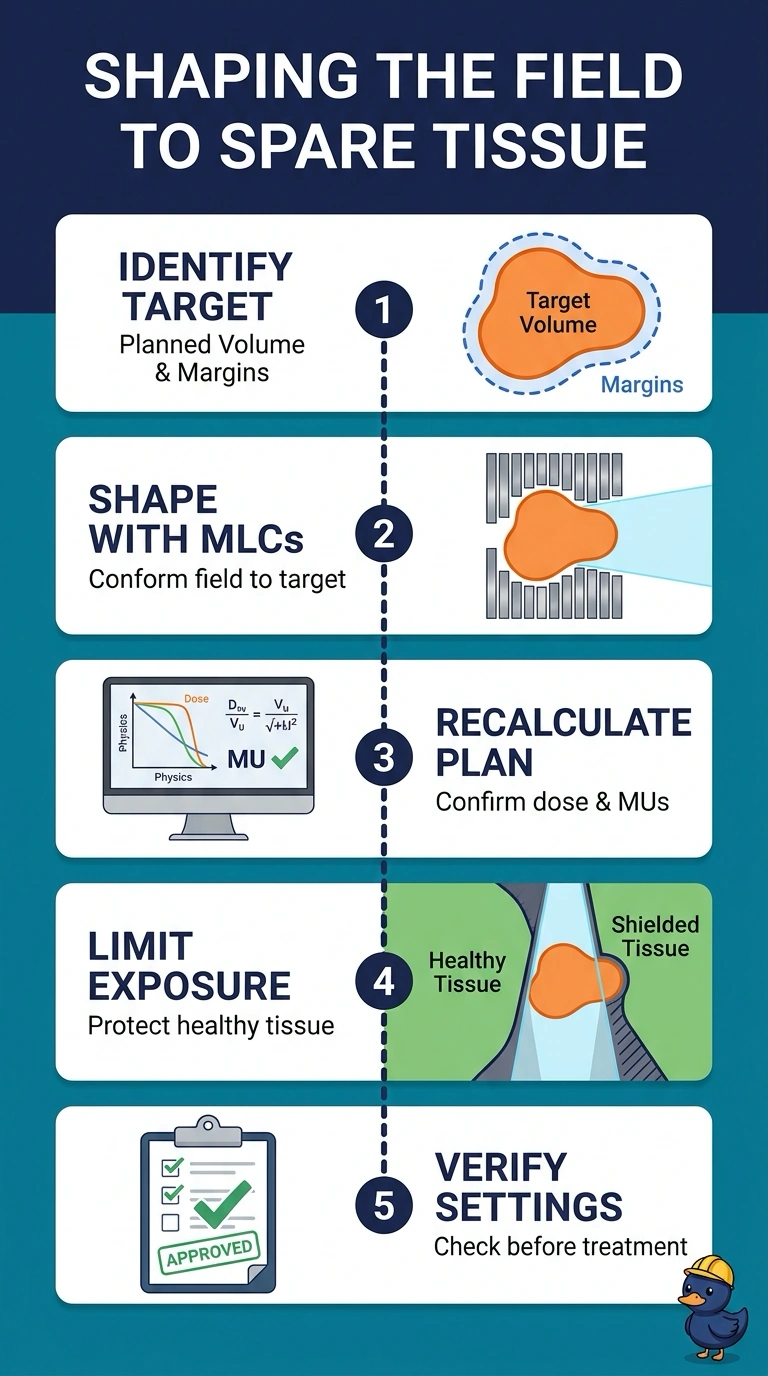
Short Explanation
You can use the MLCs like adjustable shutters to shape the field to your planned target volume while keeping the required margins. Recalculate the monitor units to preserve your target dose; this limits radiation to nearby tissue, though some scatter and leakage remain.
Full Explanation
The MLC change is best because the field is 2 cm larger than necessary on every side: shaping it to the planned target volume with required margins reduces irradiation of adjacent lung and skin, while recalculating monitor units maintains the prescribed target dose. Bolus is useful when a superficial target needs more surface dose, but it deliberately increases dose at the skin and does not remove the excess lateral field exposure; preserving target dose with monitor-unit adjustment does not correct that mismatch. Increasing energy can shift the build-up region deeper and may reduce surface dose, but the unchanged open aperture still irradiates surrounding tissue, and greater penetration can increase dose to deeper lung. A wedge can improve dose uniformity across an inclined or uneven surface, but it changes fluence rather than field boundaries, so the 2 cm margins of open beam remain exposed. Exam caveat: field shaping must retain the prescribed setup and treatment margins; trimming to the visible target alone could compromise coverage. Practical check: after shaping and recalculating monitor units, review the dose distribution and dose-volume metrics for the target, skin, and ipsilateral lung to confirm coverage is maintained and normal-tissue exposure is reduced.