
The record-and-verify printout for a 30-fraction course already documents the prescribed dose, the daily fraction, the beam energy and the treated field arrangement for every session. During a documentation audit, the supervisor notes that how the patient was placed still has no per-fraction entry. Which treatment-record element should be added to each session's documentation?
Select an answer to reveal the explanation.
Short Explanation
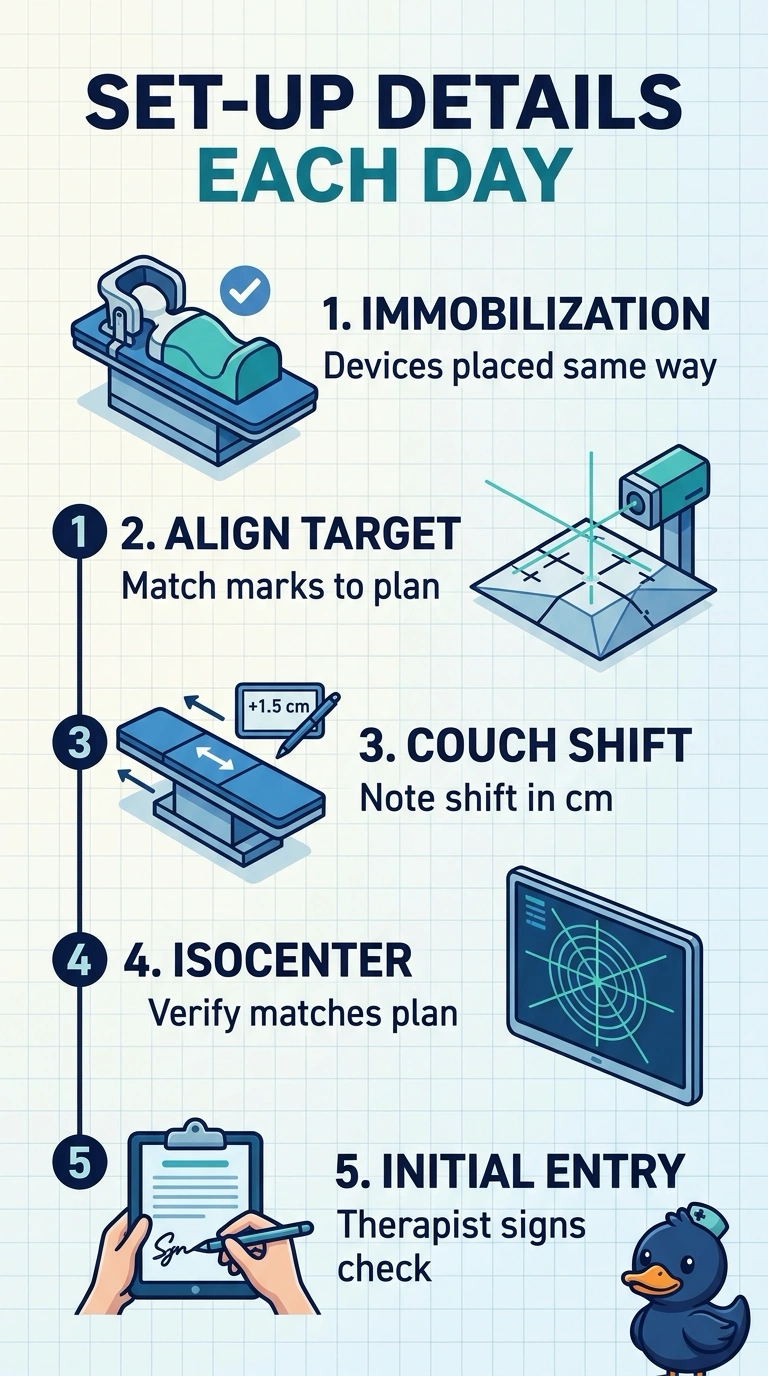
You’ve already got the dose and beam details, so the missing entry is set-up verification for each session: immobilization, alignment, and any couch or isocenter shift. Like a flight recorder, your treatment record needs to capture both what was delivered and the position that delivered it.
Full Explanation
The missing element is a session-specific record of how the patient was positioned for treatment. The correct response adds setup verification for each fraction, capturing the relevant immobilization, alignment, and any couch or isocenter shift; this documents the actual setup rather than merely the prescribed plan or delivered beam parameters. A per-fraction checklist that records immobilization and alignment is a valid setup-documentation method, but it is incomplete here if it does not record shifts: those shifts can change the final treatment position and are part of the stated verification detail. Daily image-guidance records can document a target match and the applied couch shifts, but they do not by themselves establish which immobilization was used for that fraction, so the positioning record remains incomplete. The simulation setup sheet is a standard reference for the planned indexed position and reference marks, but it describes the initial plan, not confirmation of the patient's setup at each treatment session. Exam caveat: image-guidance results and setup verification are related but distinct records; a match result should not be assumed to document every aspect of patient positioning. Practical check: compare the fraction-by-fraction record with the treatment workflow to confirm that immobilization, alignment, and any applied shifts are recorded for each delivered session.