
A patient with a large pendulous breast is booked for whole breast irradiation after lumpectomy. Shoulder stiffness makes a supine arms-overhead position uncomfortable, she cannot sustain a reliable breath hold, and the inframammary crease forms deep skin folds. At simulation, she can tolerate the supported arm position available on a prone breast board. Which treatment position and immobilization best meet her setup needs?
Select an answer to reveal the explanation.
Short Explanation
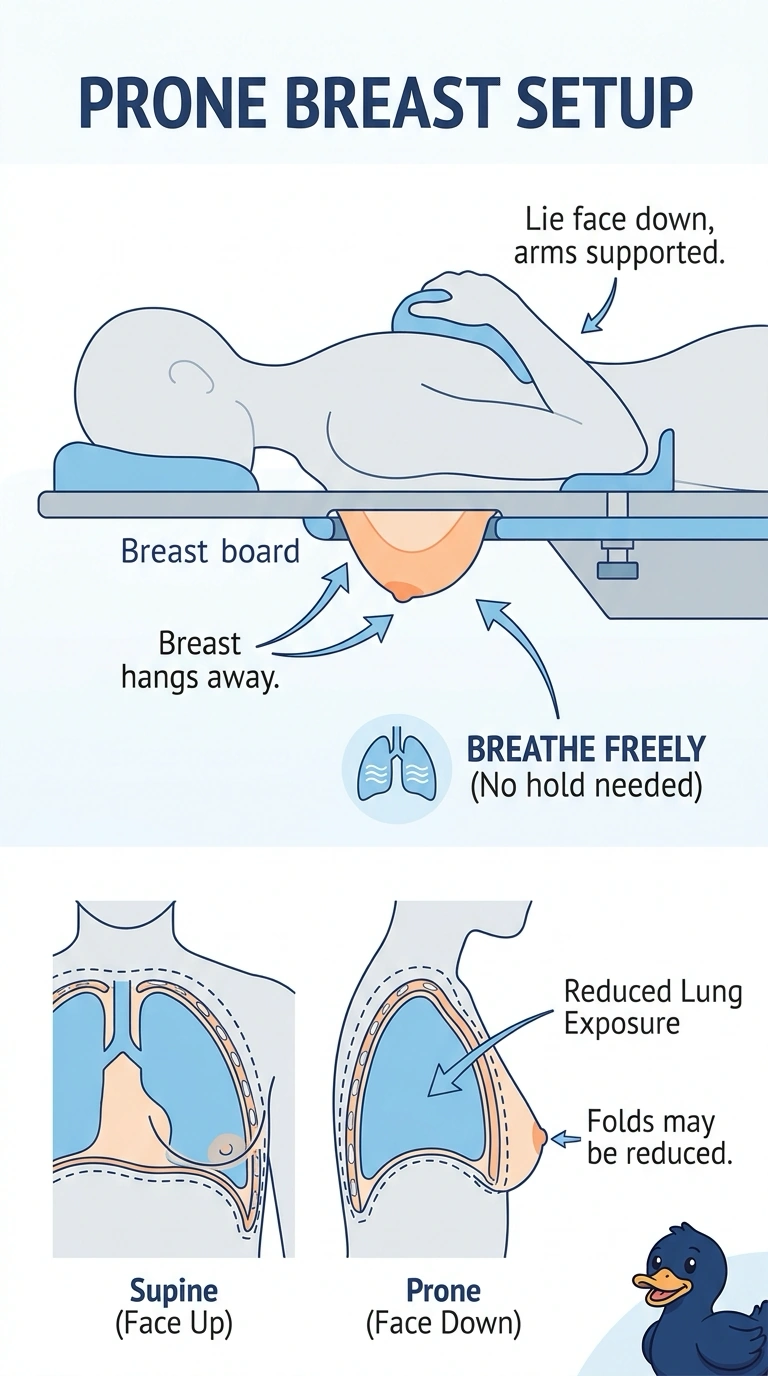
With prone positioning on a breast board, gravity helps your breast fall away from the chest wall, like letting it rest naturally, while the board supports you. You can keep your arms comfortable and breathe freely without a breath hold; skin folds may also be reduced, depending on your anatomy and setup.
Full Explanation
Prone treatment on a breast board is well suited to a large, pendulous breast because gravity can help the breast fall away from the chest wall and reduce inframammary skin apposition. The available supported arm position accommodates the patient’s shoulder stiffness, and free breathing avoids relying on a breath hold she cannot sustain. The supine breast-board setup with elevated arms uses a common whole-breast position and allows deliberate fold separation, but it fails the stated comfort requirement: she finds the overhead arm position uncomfortable. The prone setup with coached deep-inspiration breath hold preserves the tolerable position and may be used when respiratory motion management is needed, but it depends on a breath hold that this patient cannot reliably perform. The supine setup with arms at her sides is a recognized adaptation for limited shoulder mobility, and free breathing is appropriate; however, standard tangential fields without fold management do not address the deep inframammary crease, so skin apposition and dose buildup remain concerns. Exam caveat: prone positioning is not automatically superior for every breast; anatomy, target coverage, laterality, and reproducibility can favor supine treatment. Practical check: at simulation, verify the breast falls clear of the chest wall, the inframammary fold is open, and the patient can maintain the arm support comfortably throughout treatment.