
A patient with a small peripheral lung lesion that moves with breathing is scheduled for a short high-dose course. The plan must shape dose tightly around the target, account for respiratory motion, and include a volumetric image check every treatment day. Which treatment and imaging combination satisfies all three requirements?
Select an answer to reveal the explanation.
Short Explanation
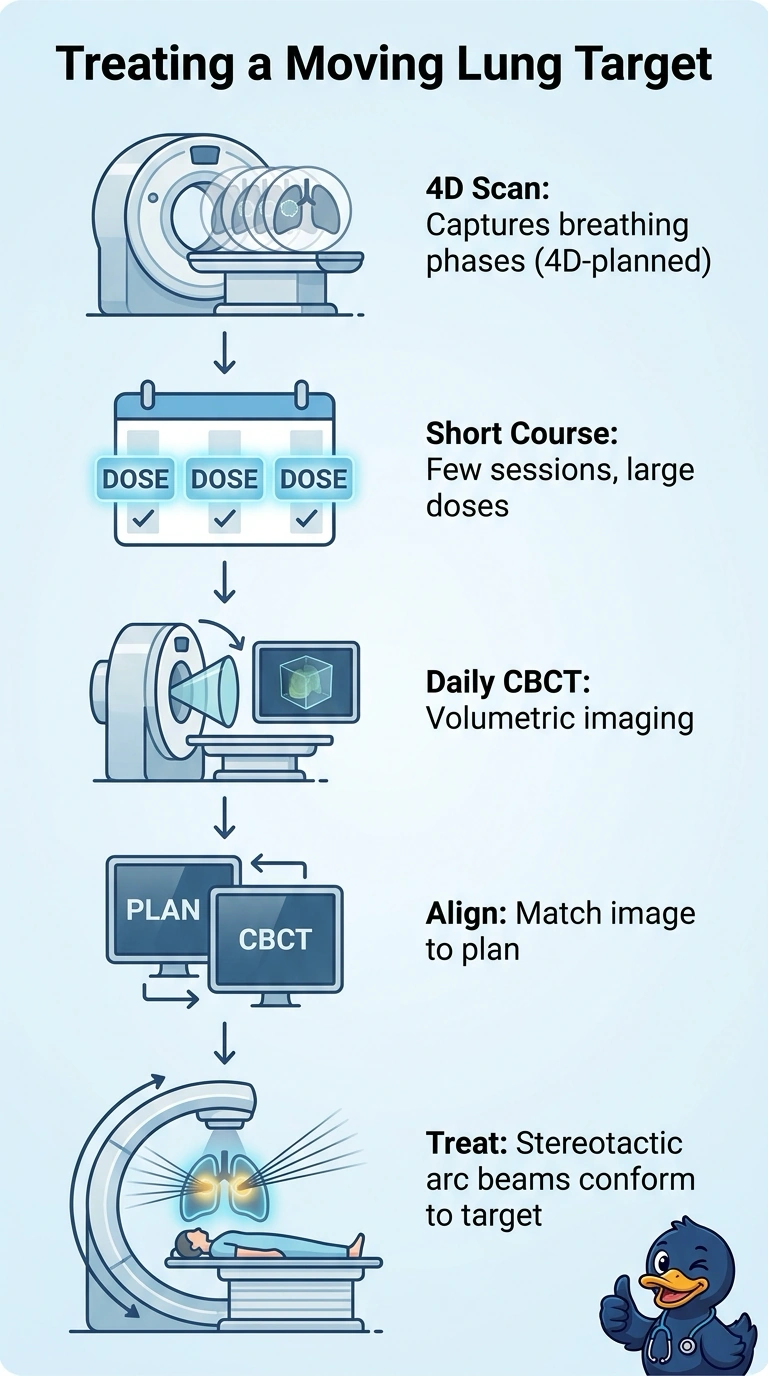
You’re looking for a 4D-planned stereotactic arc technique with daily CBCT before each fraction: the 4D plan accounts for breathing motion, while the arc tightly shapes dose around the lesion. CBCT gives you a volumetric check of the target’s position before each treatment.
Full Explanation
Four-dimensional CT captures the target at different phases of the breathing cycle, allowing the team to assess its motion and plan an appropriate target volume or motion-management strategy. Stereotactic arc delivery can shape dose tightly around a small target, and CBCT provides volumetric image guidance before each fraction. IMRT with daily CBCT in comfortable free breathing has daily volumetric imaging, but the description gives no approach to account for respiratory motion during treatment. A stereotactic arc plan with breath-hold motion control addresses motion, but daily kV images are two-dimensional and do not provide the required volumetric check. Four-dimensional-planned stereotactic arc delivery with on-board imaging only once weekly includes motion-aware planning and conformal delivery, but weekly verification does not meet the requirement for imaging every treatment day. An exam caveat is that 4D planning characterizes motion but does not, by itself, guarantee that motion is managed appropriately during delivery. As a practical check, confirm that the treatment record specifies both the motion-aware planning approach and a CBCT image check before every fraction.