
A patient with an oropharyngeal tumor needs six weeks of daily IMRT, has limited neck extension from arthritis, and cannot raise his arms above his head after shoulder surgery. Which immobilization setup best keeps his position reproducible from day to day?
Select an answer to reveal the explanation.
Short Explanation
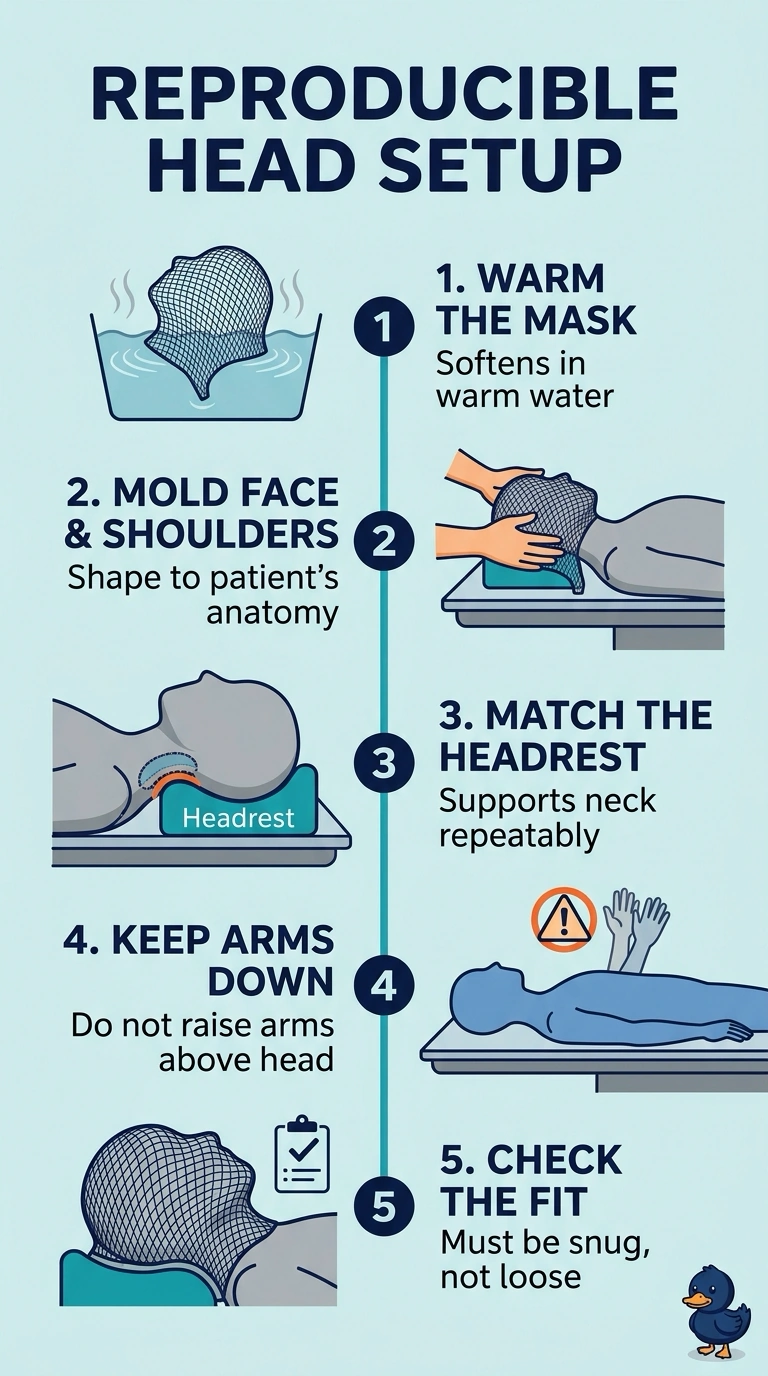
A thermoplastic mask over your face and shoulders works like a custom-fit mold to keep your position consistent each day. Pair it with a headrest matched to your neck to support a comfortable, repeatable posture for IMRT; that immobilization is key to accurate treatment.
Full Explanation
The face-and-shoulder thermoplastic mask, paired with a headrest shaped to accommodate the patient’s restricted neck extension, provides a reproducible relationship between the treatment area, head, and shoulders across daily fractions. The mask also avoids requiring the patient to lift his arms, so the setup respects the limitation from shoulder surgery while providing stable immobilization for IMRT. A standard neutral headrest may be appropriate for many head-and-neck patients, but it does not account for this patient’s arthritis-related restriction; forcing a usual head position could be uncomfortable or difficult to reproduce. A face-only mask with a well-matched headrest and indexed arm supports can stabilize the head, but leaves the shoulders less firmly immobilized, allowing their position relative to the target to vary between sessions. A face-and-shoulder mask with a suitable headrest is a sound choice, but relying on skin marks without couch indexing makes the overall setup less reliably repeatable from day to day. Exam caveat: immobilization devices and arm positions are selected for the individual patient and treatment site; an approach that is routine for one patient may not accommodate another’s limitations. Practical check: before fabrication or treatment, confirm that the patient can tolerate the planned neck position and comfortably maintain it in the mask without being asked to raise his arms.