
A pelvic target is planned with opposed anterior and posterior fields to a prescription point at midplane, with both fields the same size and the same machine settings. The plan gives 26 Gy from the anterior beam and 24 Gy from the posterior beam at that point over the full course, and the two must still sum to that course total. How should the two fields be weighted so each one contributes the same dose at midplane?
Select an answer to reveal the explanation.
Short Explanation
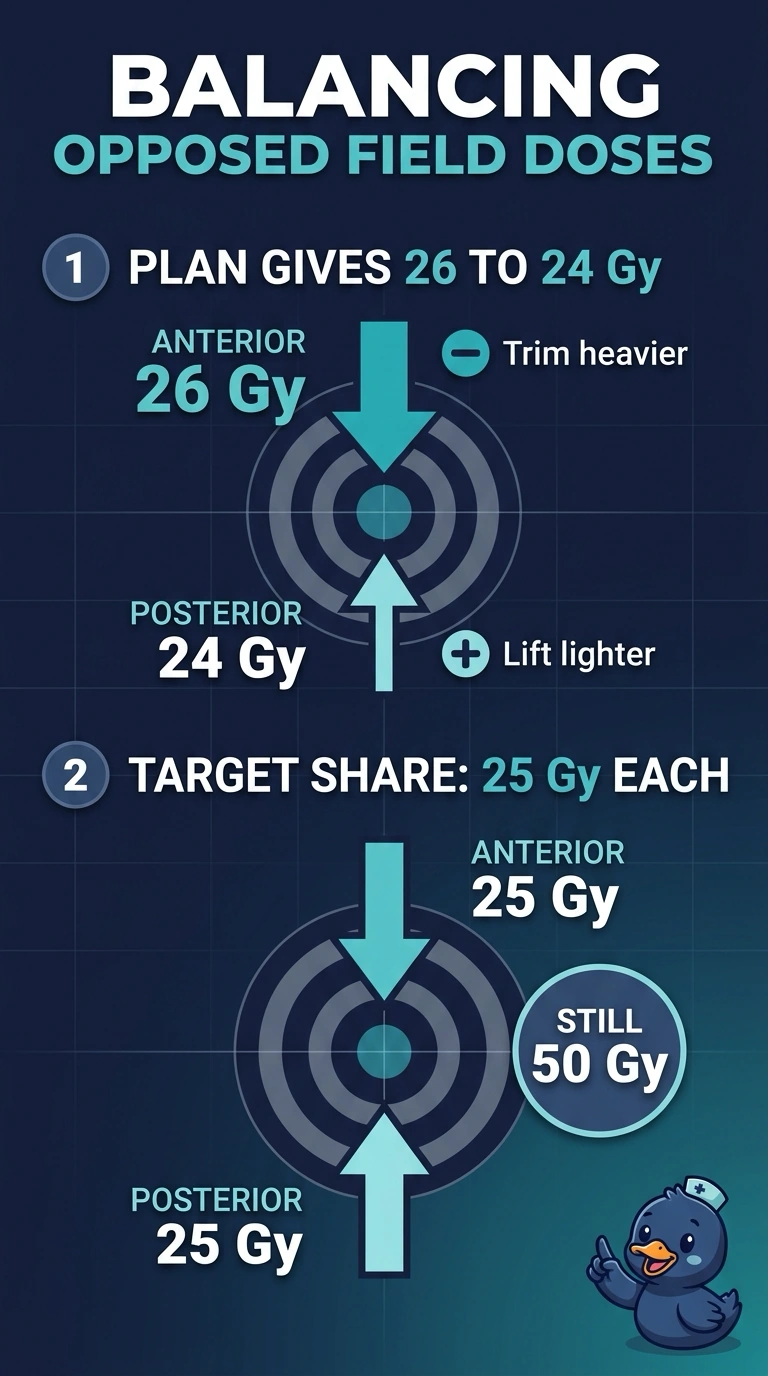
Your beams are currently split 26 Gy to 24 Gy, so reduce the anterior beam’s weight and increase the posterior’s until each delivers 25 Gy, keeping the total at 50 Gy. Like balancing two sides of a scale, weighting sets each beam’s share of the dose at the prescription point.
Full Explanation
The required total at the prescription point is 50 Gy: 26 Gy from the anterior beam plus 24 Gy from the posterior beam. Equal contributions therefore mean 25 Gy from each field. The anterior contribution must fall by 1 Gy and the posterior contribution rise by 1 Gy, keeping the course total unchanged. Equal monitor units are a familiar starting point for opposed fields with matched geometry, but monitor units do not guarantee equal dose at the point; here the stated measured contributions are already unequal, so equal-MU weighting would not meet the requirement. Retaining the 26:24 weighting correctly preserves the total, but leaves the two contributions unequal, missing the explicit balancing goal. Changing the posterior energy and recalibrating could in principle produce equal point doses, but it violates the stated requirement that both fields use the same machine settings; changing beam quality is not the requested weighting adjustment. Exam caveat: equal field size and equal monitor units do not imply equal dose when attenuation, geometry, or beam characteristics differ. Practical check: verify the recalculated dose from each field at the prescription point and confirm that their sum remains 50 Gy over the full course.