
In the usual drainage pattern, a tumor in the upper outer quadrant drains through a predictable chain of nodal groups, and that quadrant has the densest lymphatic connection of any area of the breast. Which lymphatic drainage pathway is usually the first stop for cells leaving such a tumor?
Select an answer to reveal the explanation.
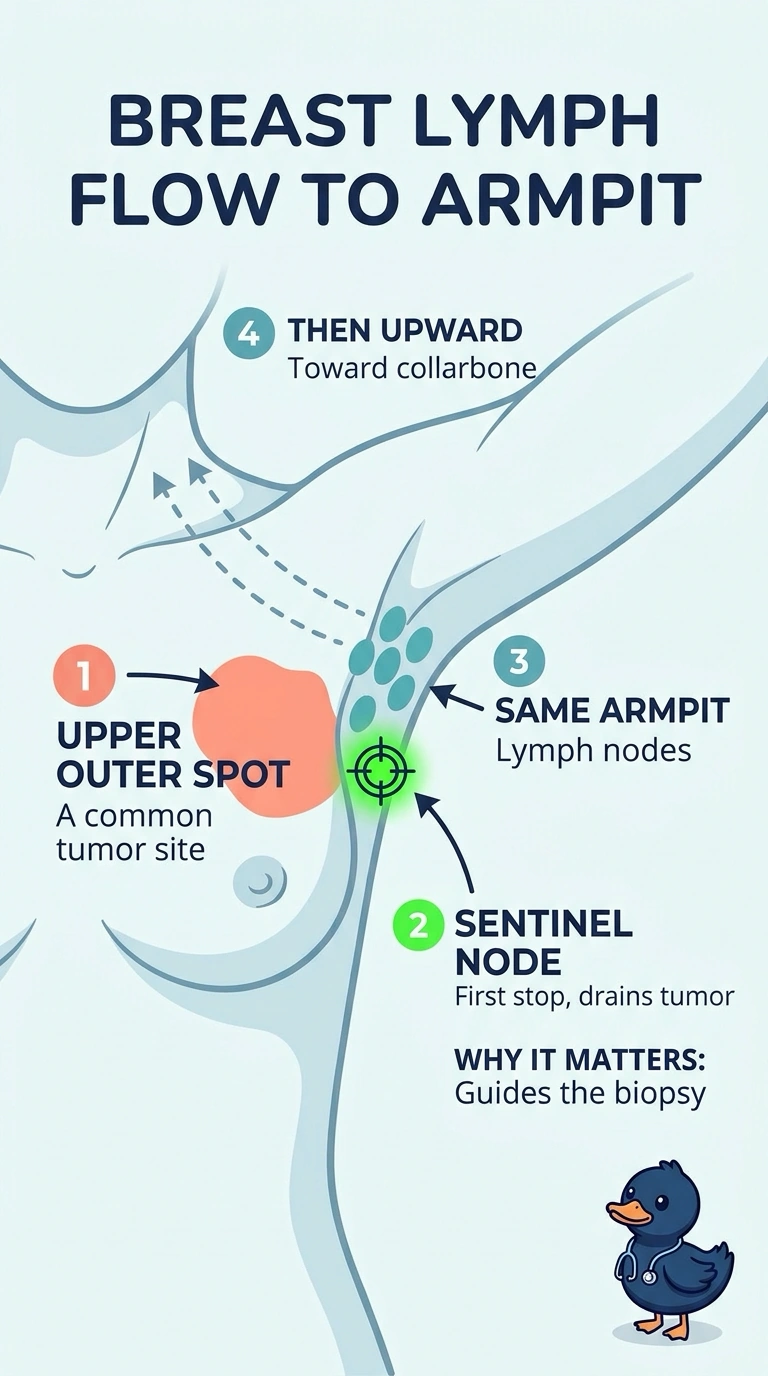
Short Explanation
When you trace drainage from an upper outer breast tumor, cells usually reach the same-side armpit first, like mail going to your local post office before a regional hub. Those axillary nodes are the expected first stop, though other routes can occur.
Full Explanation
The upper outer quadrant has the breast’s densest lymphatic connections and usually drains first to ipsilateral axillary (same-side armpit) nodes. These nodes are therefore the expected first station for tumor cells carried away in lymph; cells may then pass to higher nodal groups, including nodes toward the neck. The internal mammary, or parasternal, route describes drainage to nodes behind the sternum and is more commonly associated with tumors in the inner breast quadrants, so it is not the usual first route for an upper outer tumor. The supraclavicular route names nodes above the collarbone; these are not the expected initial station in the usual sequence and may be reached later. Contralateral parasternal drainage involves crossing the midline to nodes near the opposite breast, an atypical route rather than the usual first stop. Exam caveat: individual drainage can vary, so sentinel-node mapping identifies the first node or nodes that actually drain a particular tumor. Practical check: locate the tumor’s quadrant, then recall its usual receiving nodal group—upper outer quadrant to ipsilateral axilla.