
During a routine plan review the physicist notes that the spinal cord maximum sits just below the quoted TD 5/5 value for a short cord segment, and the physician asks how that tolerance number should be read. Which interpretation of the TD 5/5 tolerance level applies to this cord dose?
Select an answer to reveal the explanation.
Short Explanation
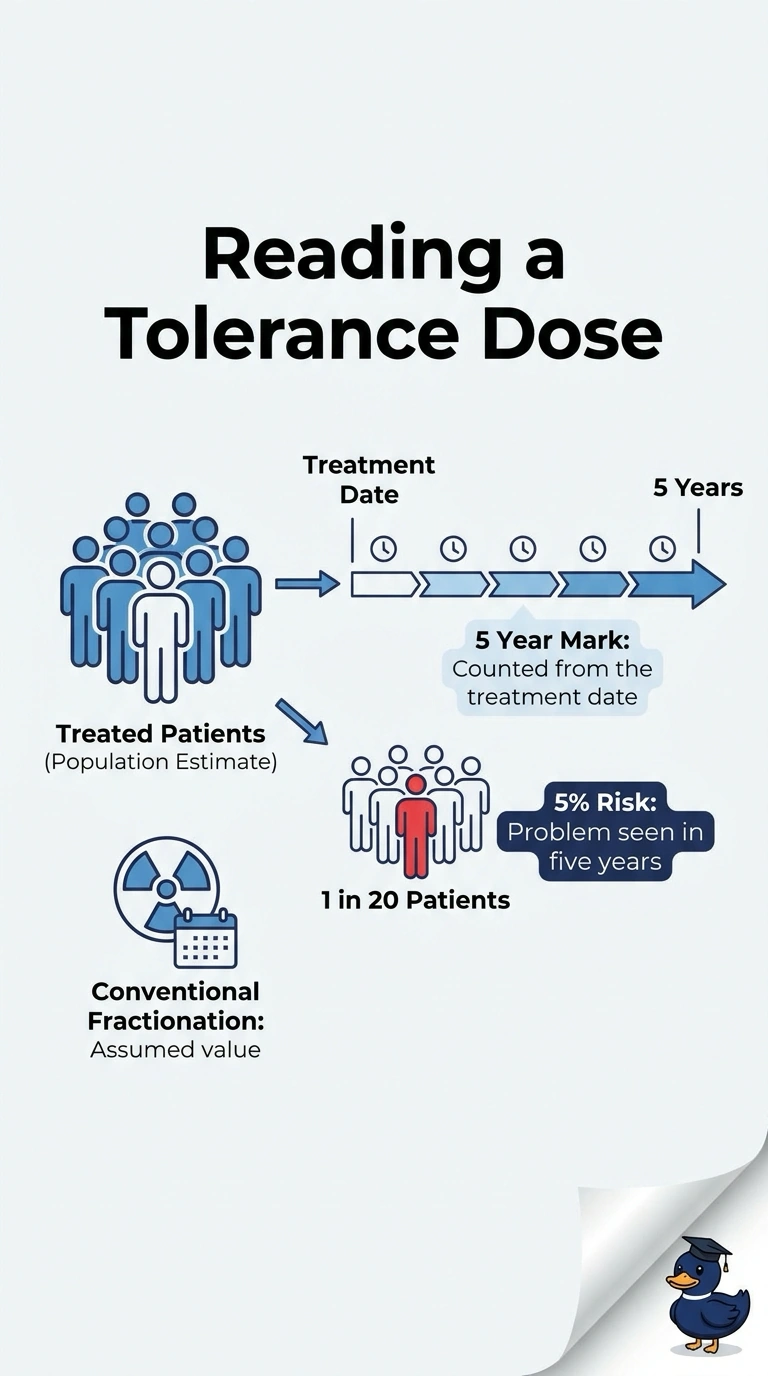
Once you pin down that five and five pairing, it means a 5% complication risk at five years for the whole group. It's like a weather forecast calling for a 5% chance of rain, not a promise that your street stays dry. The number describes risk across patients, not a guarantee for one.
Full Explanation
The TD 5/5 value is a population risk statement taken from classic tolerance tables, meaning the dose expected to produce the named complication in about five percent of treated patients within five years of receiving it. Because it is probabilistic, a cord dose sitting just under that value implies a risk slightly below five percent rather than an all clear. The absolute safety reading fails because it converts a group probability into a guarantee for one person, which tolerance data never support. The fifty percent reading confuses TD 5/5 with TD 50/5, the dose at which half of patients reach the same endpoint. The organ function reading misstates the endpoint itself, because tolerance tables score a clinical complication rather than a percentage decline in function. An exam caveat: these values assume conventional fractionation and a stated irradiated volume, so hypofractionated schedules or partial organ treatment change the comparison. A practical check: before quoting a tolerance dose, confirm fraction size, treated volume, and any prior irradiation.