
During monthly machine checks, an ionization chamber reports exposure, a phantom measurement gives the absorbed dose at depth, a worker's dosimetry record gives effective dose, and the physicist records air kerma at the panel. Which statement correctly matches each quantity to its SI unit?
Select an answer to reveal the explanation.
Short Explanation
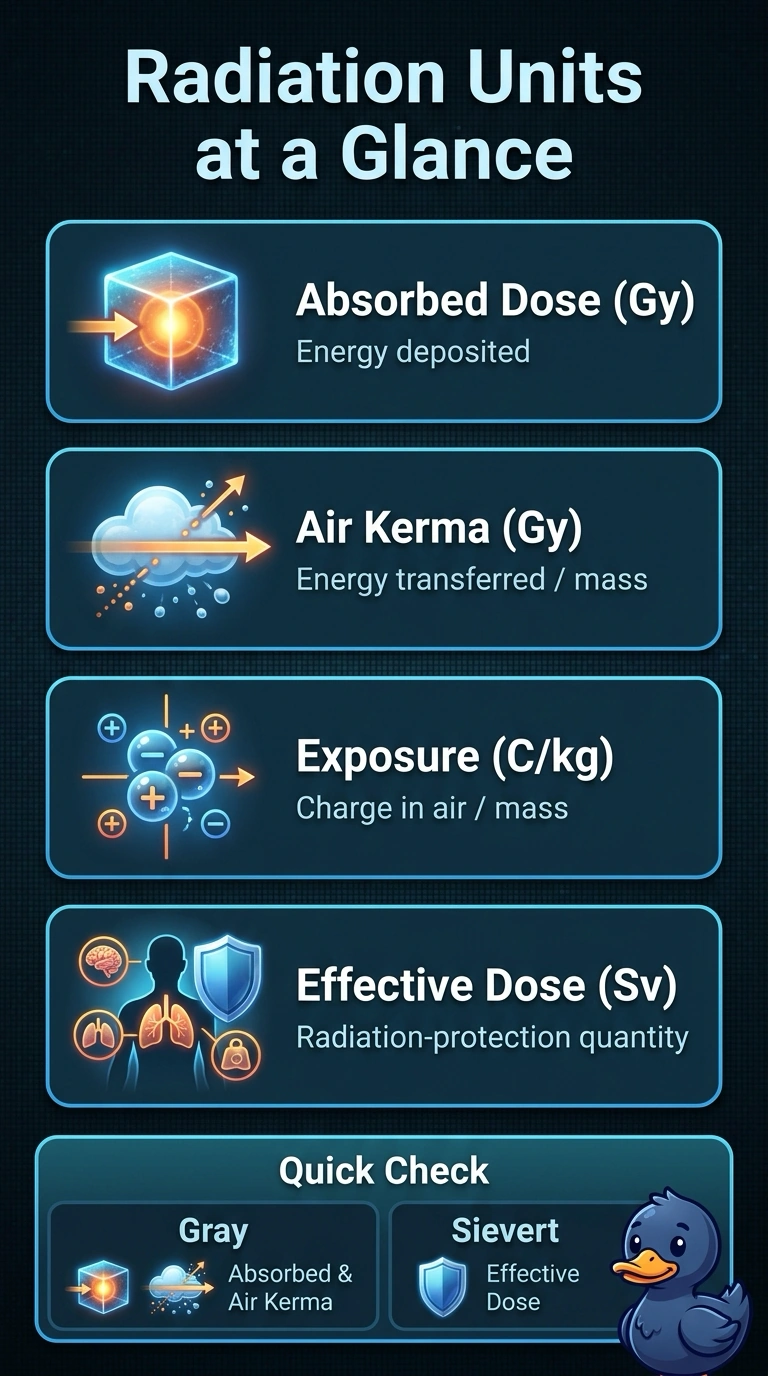
You can match each quantity to its unit like matching tools to jobs: absorbed dose and air kerma use gray, exposure uses coulombs per kilogram, and effective dose uses sievert. You’ve got the right match when each unit fits what the measurement describes.
Full Explanation
Absorbed dose is energy deposited per unit mass, so its SI unit is the gray (Gy), defined as one joule per kilogram. Air kerma is also energy transferred per unit mass and is measured in gray. Exposure measures the charge of ions of one sign produced in air per unit mass, so its SI unit is coulomb per kilogram (C/kg). Effective dose combines organ doses with radiation and tissue weighting factors and is measured in sievert (Sv); it is a radiation-protection quantity used to assess detriment, not a direct measure of an individual's exact risk. Gray is not the unit for exposure because exposure measures charge per mass, not energy per mass. Sievert is not the unit for absorbed dose or air kerma because those quantities do not include radiation-protection weighting factors. Older references may use the roentgen for exposure and the rad and rem for dose; convert these units before comparing values.