
A patient treated for squamous cell carcinoma of the head and neck three months ago returns with worsening hoarseness and noisy breathing that eases when he sits upright. His arm and leg strength is normal, he swallows without difficulty, and his facial appearance is unchanged. The oncology team orders urgent radiation to relieve the blockage. Which anatomical obstruction is this emergency treatment intended to relieve?
Select an answer to reveal the explanation.
Short Explanation
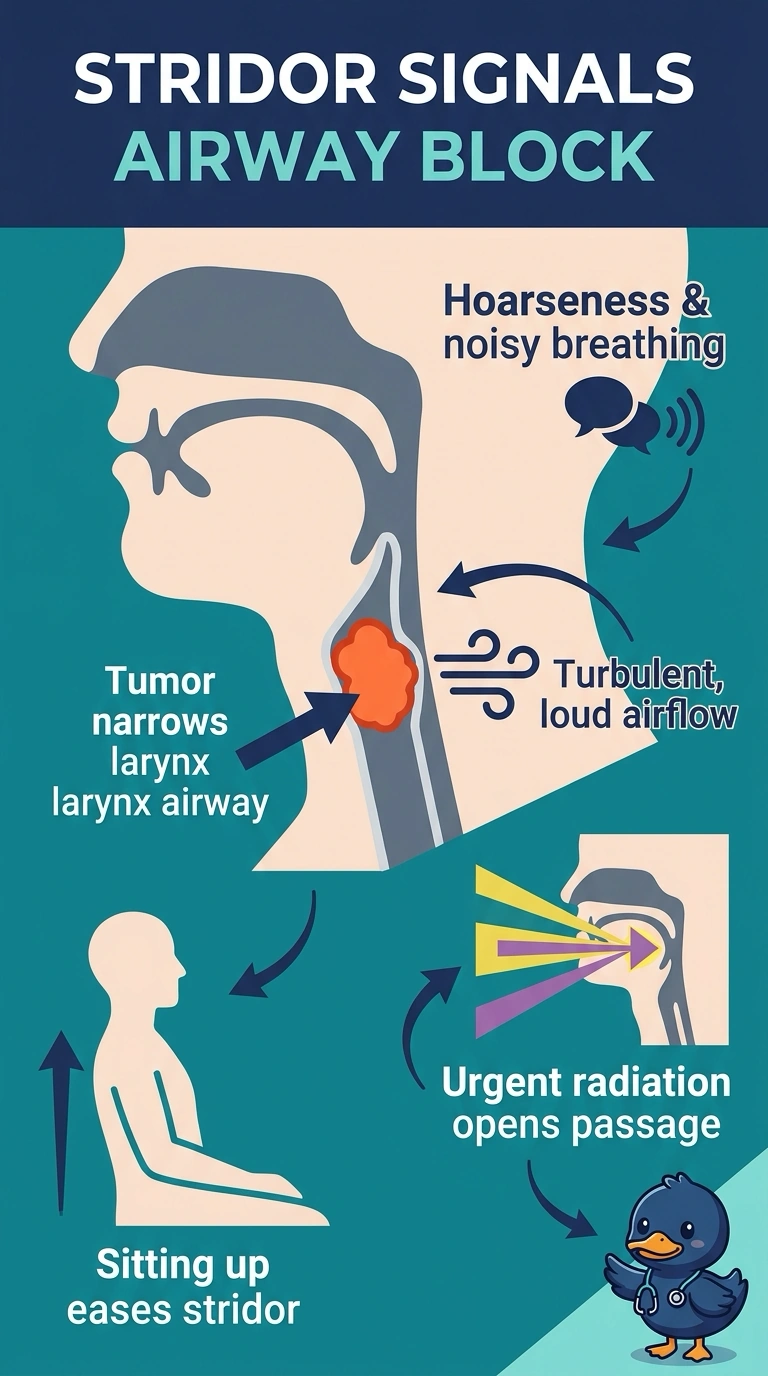
Hoarseness plus stridor that eases when upright is the classic story of a narrowed airway, and your three extra clues each knock out one rival. Normal strength clears the cord, easy swallowing clears the esophagus, and an unchanged face clears the vena cava, so you're left with a single route. Stridor should pull your eye straight to the airway in this vignette.
Full Explanation
Progressive hoarseness with stridor that improves when upright points to fixed narrowing of the laryngeal airway, and recurrent tumor in the larynx or trachea is the mechanism that cuts the airway cross-section enough to need urgent palliative radiation, with vocal cord involvement explaining the voice change and turbulent flow explaining the noise. Each competing obstruction is a legitimate emergency indication but contradicts exactly one fact you were given. Esophageal compression presents with dysphagia and odynophagia, yet this patient swallows without difficulty, so that route is out. Superior vena cava obstruction produces facial plethora, periorbital edema, and arm swelling, yet facial appearance is unchanged here. Spinal cord compression produces weakness, hyperreflexia, and bladder dysfunction below the lesion, yet strength is normal throughout. Exam caveat: the symptom pattern decides the anatomic site rather than the history of the prior tumor alone, because a treated head and neck patient can present with any of these. Practical check: before the planning meeting, match each of the four obstructive syndromes against the patient's own symptoms and name the single finding that supports your choice.