
A 70-year-old with a localized 3 cm lung tumor and severe COPD is judged unfit for surgery, and staging shows no nodal or distant spread. Which treatment approach best matches this patient's localized, inoperable disease?
Select an answer to reveal the explanation.
Short Explanation
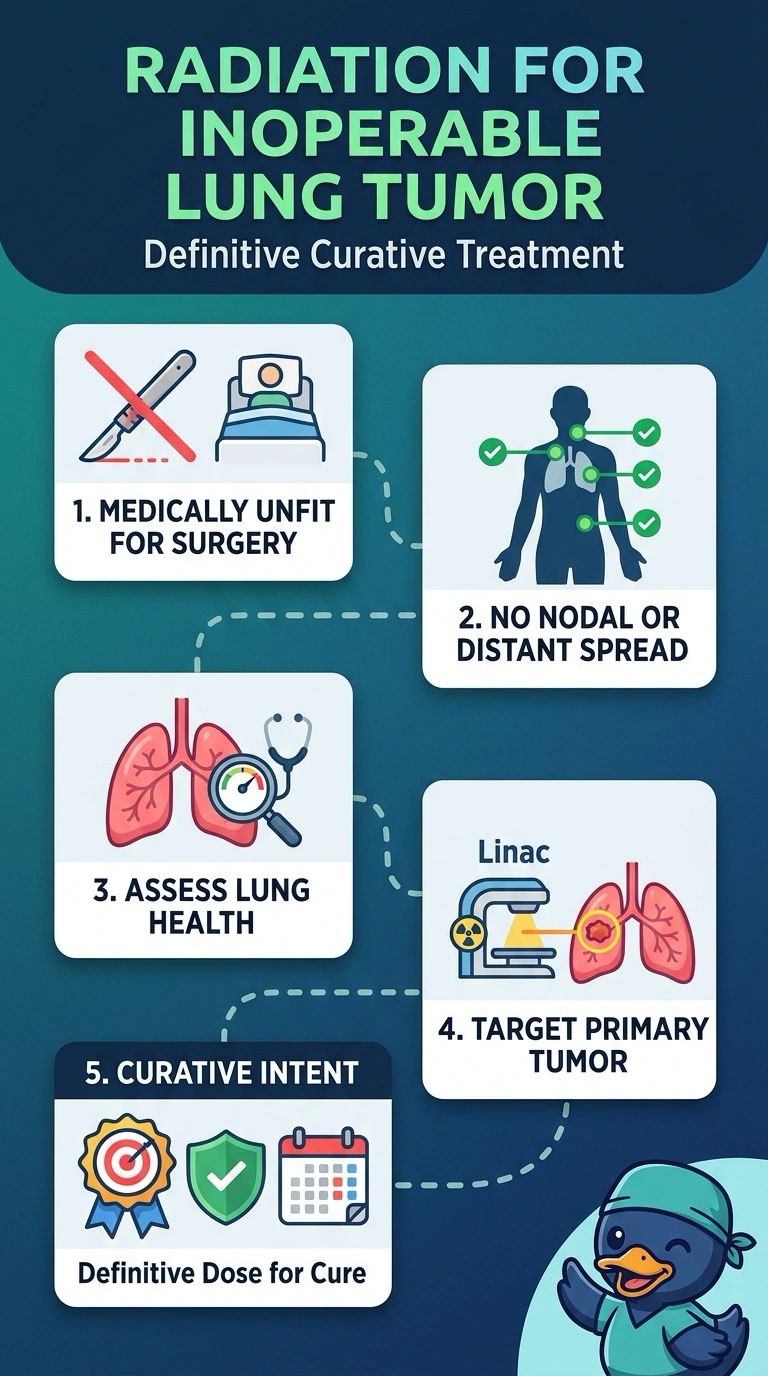
Since your cancer is localized and surgery isn’t safe, definitive radiation targets the tumor still in place with the goal of cure—like treating the source directly. The schedule is tailored to the tumor and your health.
Full Explanation
Definitive radiation to the intact primary with curative intent is appropriate for a localized lung tumor when severe COPD makes surgery unsafe. It treats the known cancer without requiring an operation and aims for durable control or cure; for a small, node-negative tumor, stereotactic body radiation therapy is often considered if anatomy and normal-tissue constraints permit. Concurrent chemoradiation can be a sound curative approach for unresectable, node-positive locally advanced disease, but adding regional nodal treatment here does not fit the documented N0 staging and exposes a frail patient to avoidable toxicity. Adjuvant platinum chemotherapy may be used in selected higher-risk or more advanced settings, but it is not routinely indicated for a small node-negative tumor after definitive local radiation; the added systemic treatment is the mismatch. Hypofractionated radiation is commonly used for palliation when symptom relief, rather than cure, is the goal. Its palliative intent fails the stated curative-treatment requirement despite the localized target. Exam caveat: “inoperable” does not by itself specify the radiation technique; tumor location, histology, pulmonary reserve, and dose constraints matter. Practical check: confirm staging and review pulmonary function and the radiation plan with a multidisciplinary team before selecting dose and fractionation.