
During a planning conference the team reviews a core biopsy from a patient's breast mass. The pathology report identifies invasive carcinoma with tumor cells forming glands in part of the specimen, marked variation in nuclear size and shape, and frequent mitoses; the Nottingham score is 8 of 9 across its three features. Which statement correctly classifies this tumor's histologic type and grade?
Select an answer to reveal the explanation.
Short Explanation
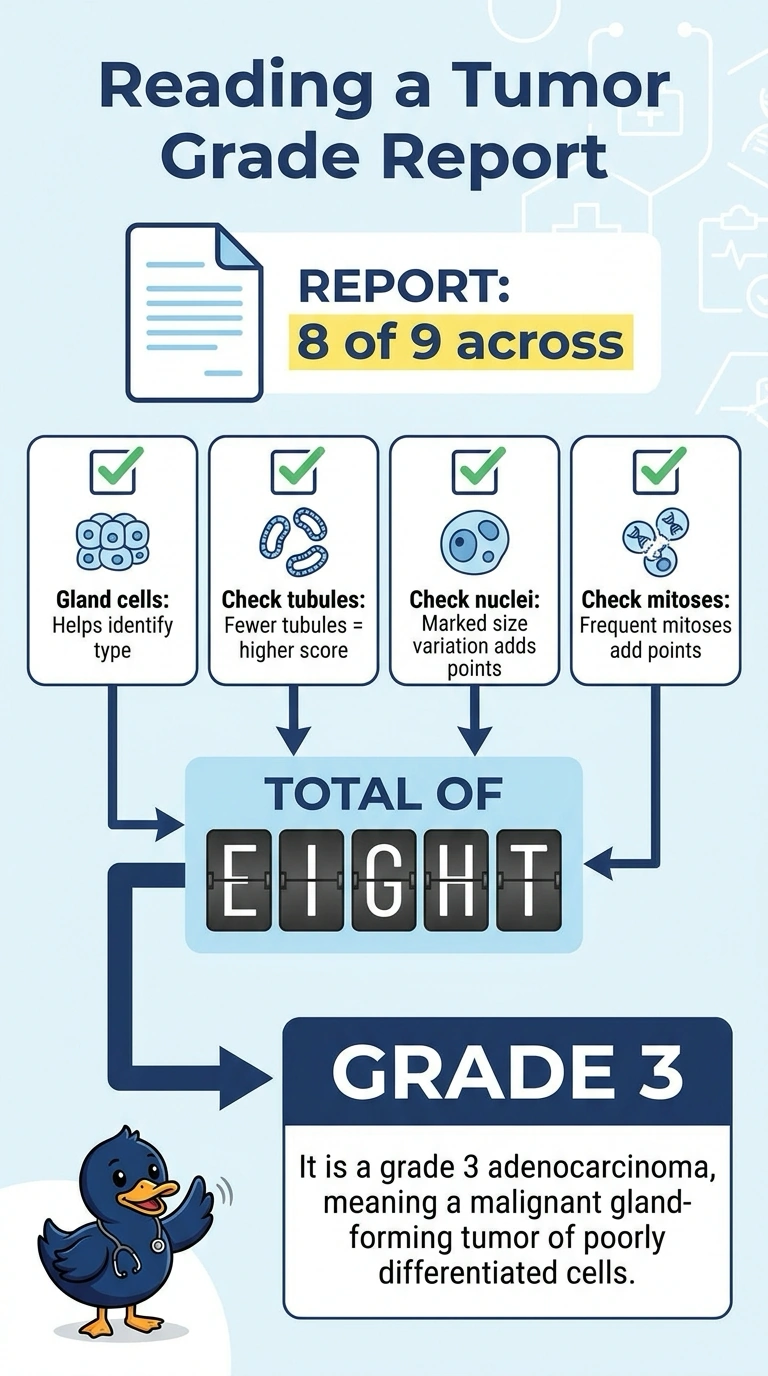
You’ve matched both parts of the report, which is exactly what you need to do. The gland-like structures identify the tumor type, while a Nottingham score of 8 places it in grade 3. Grade 3 means the cells look least like the tissue they came from.
Full Explanation
The Nottingham grading system for invasive breast carcinoma scores tubule formation, nuclear pleomorphism, and mitotic activity; the three scores are added, and a total of 8 or 9 is grade 3, indicating poorly differentiated tumor cells. Adenocarcinoma names a malignant epithelial tumor with glandular differentiation, so the gland-like structures and high Nottingham score establish the type and grade, respectively. A grade 2 adenocarcinoma would be moderately differentiated, which does not fit the reported total of 8. A grade 3 squamous carcinoma is not supported by gland formation; squamous differentiation is characterized by features such as keratin pearls and intercellular bridges, which are not described. Small cell carcinoma is a different, high-grade neuroendocrine tumor type, typically showing scant cytoplasm and nuclear molding, also absent from the report. An exam caveat is that grade is separate from stage, so a grade 3 tumor can still be found early. Before recording the diagnosis, confirm the pathologist’s wording for both histologic type and grade.