
A patient with head-and-neck cancer is simulated for a course covering the cervical nodes that will repeat daily for several weeks. The patient cannot keep both arms raised for more than a few minutes and reports neck pain whenever the head turns to the side. Which immobilization setup should be chosen for reproducible daily positioning?
Select an answer to reveal the explanation.
Short Explanation
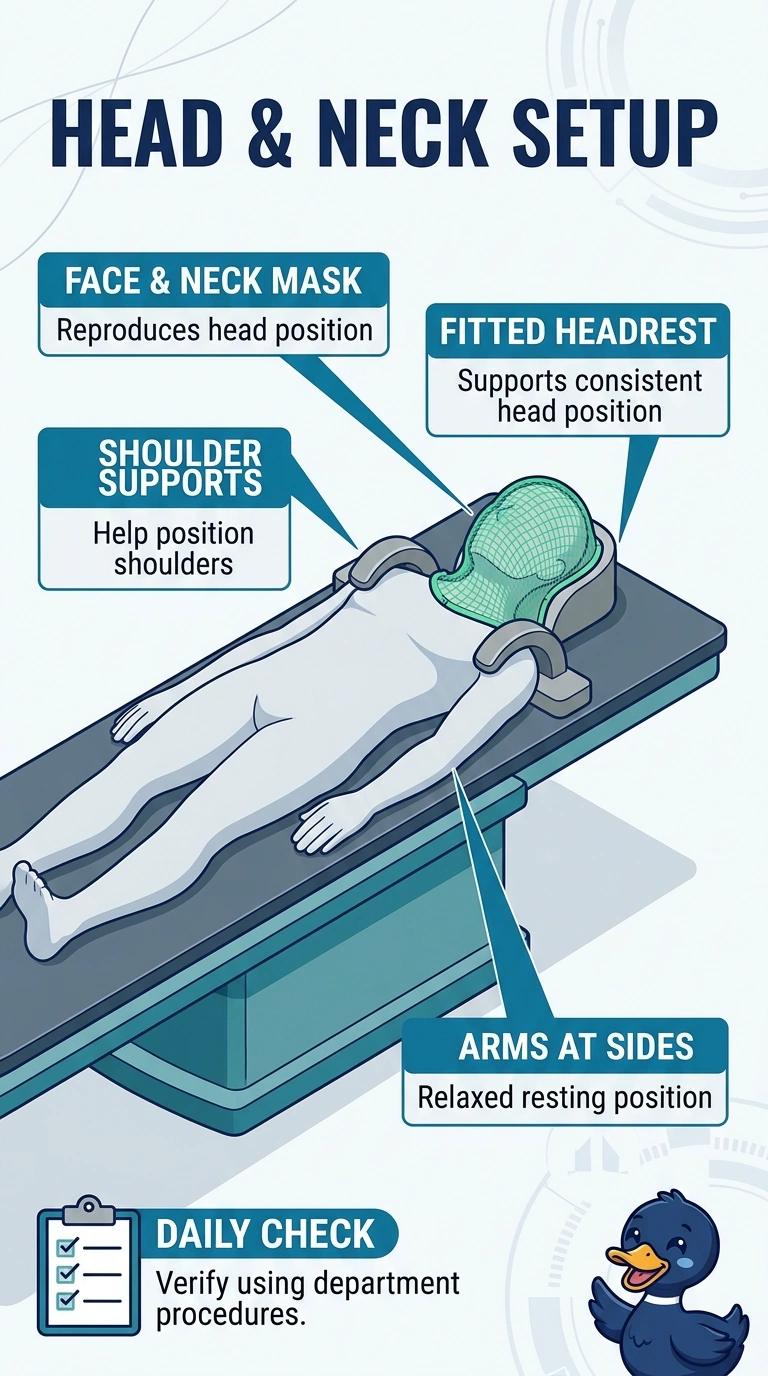
Your daily setup needs to keep your head in the same neutral position, like using a snug guide that returns it to the same spot each time. A face-and-neck thermoplastic mask with a headrest and shoulder supports provides reproducibility without requiring you to hold your arms up or turn your painful neck.
Full Explanation
The face-and-neck thermoplastic mask, headrest, and shoulder supports provide a reproducible, neutral setup for cervical-node treatment while allowing the arms to rest comfortably at the patient’s sides. This accommodates the patient’s limited arm endurance and avoids the painful head turning that could make daily positioning intolerable. A mask and headrest without dedicated shoulder supports may stabilize the head and neck, but the shoulders can shift between sessions, reducing reproducibility for a treatment area that includes the cervical nodes. A headrest and shoulder supports with tattoos and lasers but no mask can provide useful alignment cues; however, omitting the mask removes a key means of consistently immobilizing the face and neck. A mask, headrest, and shoulder supports with the head slightly rotated may suit some beam arrangements, but rotation conflicts with this patient’s reported neck pain and should not be imposed for convenience. Exam caveat: immobilization choices must be individualized; a setup commonly used for another patient or site is not automatically appropriate here. Practical check: during simulation, confirm the patient can maintain the neutral, arms-resting position comfortably and that the mask, headrest, and shoulder supports reproduce the intended alignment.