
A breast core biopsy returns an invasive carcinoma with no special type. Microscopy shows tubule formation across about 40% of the tumor, moderate nuclear variation, and a moderate mitotic count, scored 2, 2, and 2 in the three-part grading system. Which histopathologic grade and type should be recorded for this tumor?
Select an answer to reveal the explanation.
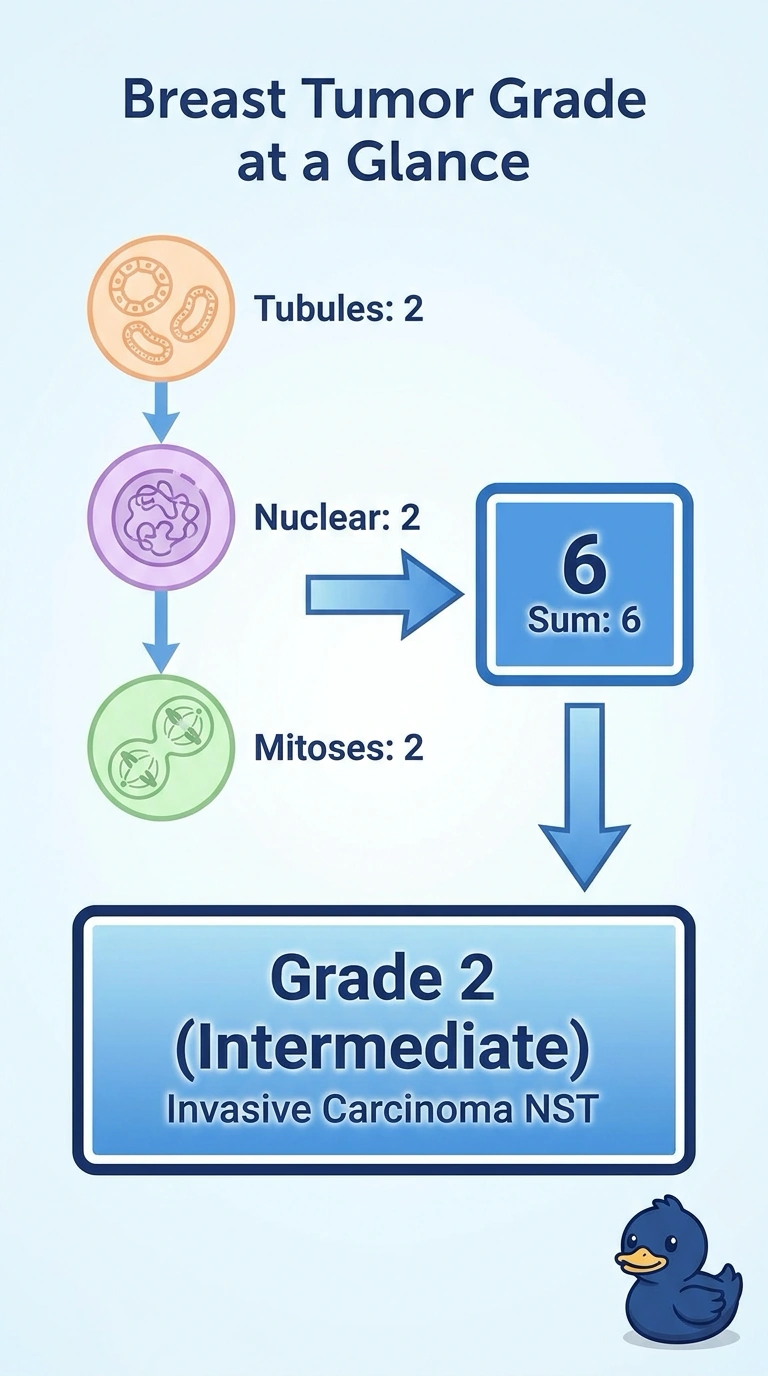
Short Explanation
You’ve added the three scores to get six, which falls in the middle band of the Nottingham grading system. With each component scoring two, this tumor is grade 2, and its type remains invasive carcinoma of no special type. You’re on the right track by using the combined score rather than any single feature.
Full Explanation
The tumor should be recorded as a Nottingham grade 2 invasive carcinoma of no special type. The Nottingham system adds the scores for tubule formation, nuclear pleomorphism, and mitotic activity; here, 2 + 2 + 2 = 6, which falls within the grade 2 range of 6–7. Assigning grade 1 based on the lowest grade represented in a core biopsy reflects a real concern about heterogeneity and under-sampling, but it is not the grading rule: the observed combined score determines the grade. Assigning grade 3 by applying a high-grade mitotic threshold and changing the reported mitotic score to 3 is also unsupported; the reported score of 2 must be retained, giving a total of 6 rather than 8. Calling the tumor a tubular carcinoma preserves grade 2 but misclassifies its histologic type. Tubular carcinoma is a special type generally requiring a nearly pure tumor, commonly more than 90% tubular architecture; 40% tubule formation does not meet that threshold. An exam caveat is that tubule percentage alone does not determine the overall grade, because all three components contribute. In practice, check that the mitotic score was assigned using the laboratory’s validated field area and thresholds, since microscope field size affects mitotic-count interpretation.