
A post-mastectomy patient receives a 6 MV field to a superficial chest wall target that reaches the skin, and the plan's MLC leaves already match the target outline. In vivo measurements put the surface dose well below prescription while the reading at 1 cm depth is on target. Which beam modifier should be used to bring the skin dose up to prescription?
Select an answer to reveal the explanation.
Short Explanation
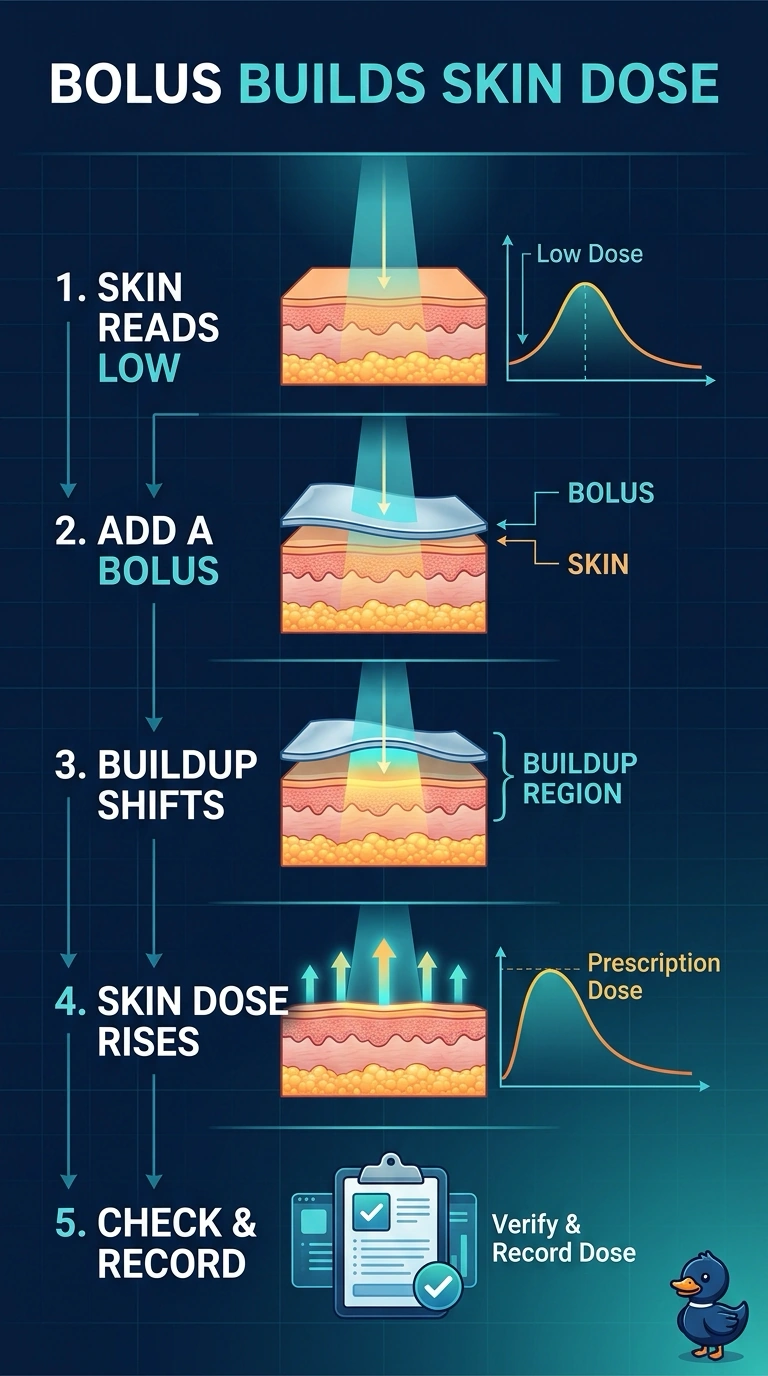
Buildup is why an open 6 MV beam leaves your skin reading low, and bolus increases dose near the surface by adding tissue-equivalent material where the beam enters. The amount of increase depends on the bolus and treatment geometry, so the plan and measurements should be checked. A wedge tilts the dose profile and an MLC reshape changes the field border; neither is the appropriate way to increase entrance dose. Bolus is used when the prescription requires dose at the surface.
Full Explanation
At the surface of an open 6 MV beam, secondary electrons are still in flight, so dose in the buildup region is below the dose at 1 cm depth. Bolus places tissue-equivalent material against the skin, adding scattering material and shifting the buildup region toward the surface. It can increase the skin reading, but the amount depends on bolus thickness and treatment geometry; it can also change dose at 1 cm, so the plan and measurements must be checked rather than assuming that reading stays unchanged. A physical wedge creates a lateral dose gradient and is not the appropriate modifier for correcting low surface dose. Reshaping MLC leaves addresses field conformity, which the plan already achieved, and does not correct the buildup effect within the field. A contour-compensating block attenuates the beam in selected regions; it does not add entrance dose. Bolus thickness and schedule are determined by the treatment team, so the concept—not a fixed number—is the key point.