
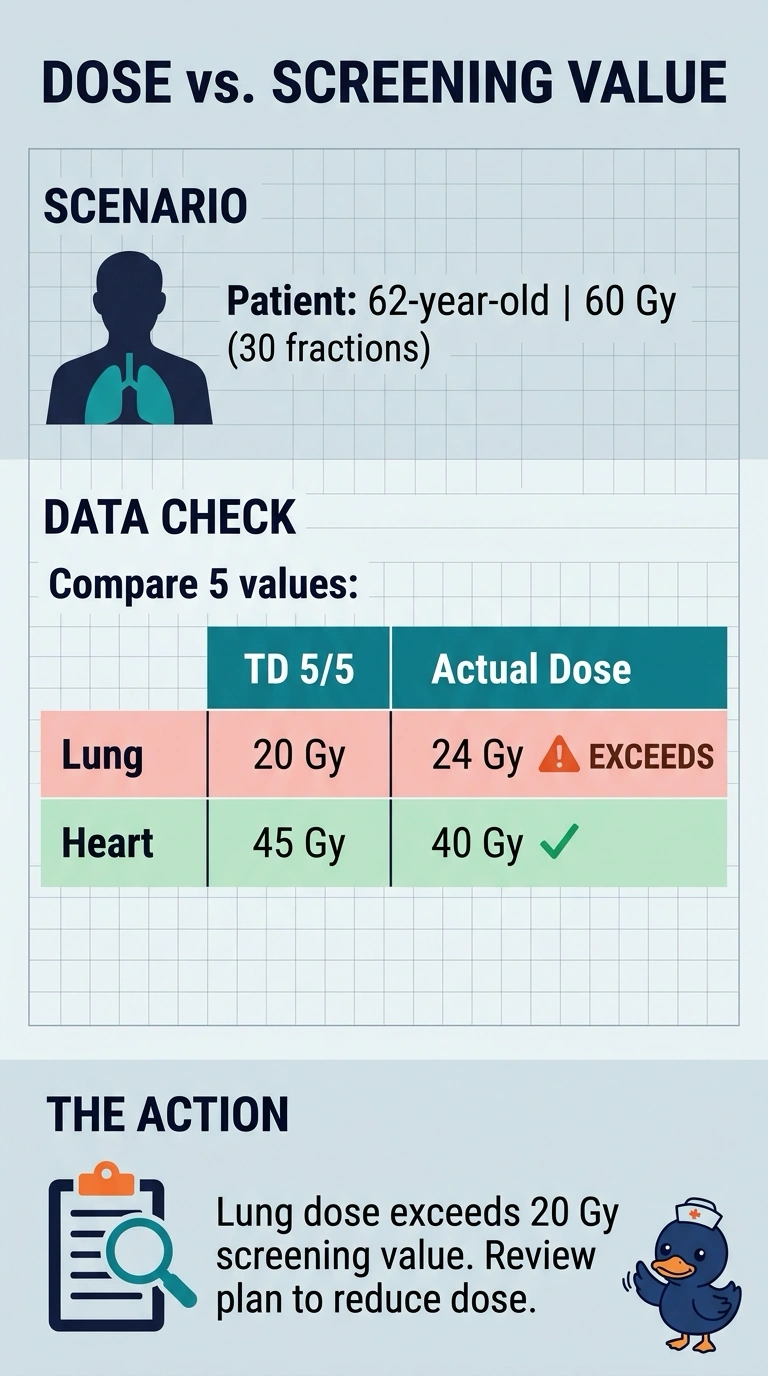
A treatment plan for a 62-year-old with lung cancer delivers 60 Gy in 30 fractions to a mediastinal target. The plan's dose-volume summary reports a mean dose of 24 Gy to the combined lung volumes and 40 Gy to the heart, while the department's planning-screening table lists TD5/5 values of 20 Gy for lung and 45 Gy for heart. According to this table, which comparison should trigger a plan review?
Select an answer to reveal the explanation.
Short Explanation
Compare each organ’s dose with its own screening value: your lung mean dose is above 20 Gy, while the heart dose is below 45 Gy. Treat the TD5/5 value like a review flag, not a hard stop—the lung result should trigger a plan review.
Full Explanation
A TD5/5 value estimates the dose associated with a defined complication in five percent of patients by five years; it is an organ-specific risk benchmark, not a universal hard limit. In this question, the department's table is explicitly used as a planning-screening reference, and the mean lung dose exceeds its listed value while the heart dose remains below its own. That comparison identifies the lung as the structure triggering review under the stated criteria. Comparing organ doses with the prescribed target dose does not answer whether they meet their own screening values, and closeness to a value is not the same as exceeding it. Dividing the doses by the number of fractions does not establish compliance with the listed course-dose values. In practice, use the current protocol's dose-volume constraints and account for fractionation and clinical context.